
Tuesday, May 1, 2012
Skype Leak


Saturday, April 21, 2012
Chances of Dying (InfoGraphic)

This is an interesting infographic that is floating around that depicts the statistical likelihood of dying from any given event.
It's a commonly known fact that societies tend to focus irrationally on certain threats over realistic ones, and this infographic just might help dispel some irrational fears that you hold.
For example, I was surprised to see that skydiving is less risky behavior than driving a car in traffic, which I do quite regularly. Looks like it may even be roughly as dangerous as flying commercially (well, except you probably won't have to deal with the TSA when you get on that prop plane at a small rural airport prepping for your skydive).
Note how dangerous any mountaineering is in Nepal. Ouch. Not great odds.
Tuesday, April 17, 2012
White Lies Affect Your Behavior

Monday, April 16, 2012
Free OWASP .NET Development E-Book

Friday, April 13, 2012
How To Send Digital Messages using HAM Radio
 This is a bit of a stretch from the normal topics, but in a severe disaster scenario (think Hurricane Katrina or third world country), it may be desired to send real time digital text communication when there is no communication infrastructure in place any longer (i.e. telephone lines are down and the Internet "tubes" were all clogged up).
Here is a clever, low budget way to accomplish digital text communication over significant distances with very inexpensive components, namely a HAM radio, a netbook, an open source software application called FLDIGI, and a low tech way of connecting them together.
A clever improvement to this might be to encrypt the text data before its transmitted, which should be possible using a variety of tools, possibly even GnuPG (if the transmission medium is reliable enough to send the complete block of encrypted text without drops).
Wednesday, April 11, 2012
Measuring Wallets' Contents with Metal Detectors
 Turns out it may be more than RFID protection you may need for your wallet. New Scientist reports how some academics at University of Washington - Seattle can exploit some of the metallic features of dollar bills to count the money in your wallet. An excerpt:
They found an ordinary handheld metal detector was able to pick up a dollar bill from 3 centimetres away, and placing the notes behind plastic, cardboard and cloth did little to block the signal. Adding further bills in $5 increments increased the strength of the signal, making it is possible to count the number of bills, though converting this into an actual dollar value would be difficult as notes of different denominations contain the same amount of magnetic ink.Using larger metal detectors such as those found in airports should also increase the range of sensing, though detecting banknotes in such situations would be trickier as many other sources could interfere with the signal.
Saturday, April 7, 2012
Visa's New Data Center
 We just covered the NSA's new data center, so it seems appropriate to mention Visa's new data center, complete with a moat!
 Notice how castle features are still king for physically securing our data in the information age.
An excerpt:
The 8-acre facility looks like any other industrial park in a sleepy suburb. But the serene setting masks hundreds of cameras and a crack team of former military personnel. Hydraulic bollards beneath the road leading to the OCE can be quickly raised to stop an intruding car going 50 mph. Any speed faster, and the car can't navigate a hairpin turn, sending it into a drainage pond that functions as a modern-day moat.Here is the exact location of the data center. So much for trying to hide from Google Maps!
The data center resembles a fortress, with dogged attention to detail. It can withstand earthquakes and hurricane-force winds of up to 170 mph. A 1.5-million-gallon storage tank cools the system. Diesel generators onsite have enough power, in the event of an outage, to keep the center running for nine days. They generate enough electricity for 25,000 households.
Once you get clearance from a guard station, get an OK from a roving security guy in a golf cart, and surrender a photo and fingerprint inside, the adventure begins.
View Larger Map
Saturday, March 31, 2012
Stanford University Online Cryptography Course
 Stanford University has a free online Cryptography Course. Looks very interesting for someone who wants to peel back the layers of the onion, but isn't scared off by the math. (Many applied cryptographers aren't necessarily experts in the theoretical mathematical aspects and vice versa.)
Professor Dan Boneh gives an introduction to the course:
Thursday, March 29, 2012
Using VPNs to Bypass Content Restrictions

Some content providers, like Hulu, have restrictions on certain content to make it only available in specific countries. They implement these policy goals in the form of restricting access to foreign-looking IP addresses.
If you are behind a foreign IP address and wish to view the content anyway, the current solution is to just use a VPN service to appear local.
Thursday, March 22, 2012
In Memory: Bill Zeller
 Having just caught up on the positive achievements of Alex Halderman, we have discovered that another promising young mind has been lost forever.
Bill Zeller was also a member of Ed Felten's Freedom to Tinker crew and a PhD student at Princeton. Bill also is known for creating MyTunes, which was one of the first implementations to prove Digital Rights Management (DRM) is really the emperor without clothes.
You can read Bill's tragic story here, or his own words here. Even by those who did not directly know him, he will be missed.
Wednesday, March 21, 2012
Alex Halderman on Internet Voting
 Computer Science Professor J. Alex Halderman is an upcoming academic star that we at Securology have been watching for awhile now, since some of the earliest days of all the great work put on at Princeton by Ed Felten and his Freedom to Tinker group (an excellent blog). Halderman, having completed his PhD (Bell Labs UNIX and C programming language creator Brian Kernighan was on his PhD committee!), has moved on to the University of Michigan as a member of the faculty and is continuing his excellent work at the intersection of technology and public policy, which always means security and privacy issues are in the spotlight.
Here is an excellent interview with Halderman (presumably shot at the 2012 RSA Conference) on how he and his students (legally) hacked the mock trial of Internet Voting put on by Washington D.C., and why Internet Voting should not be employed for a very long time.
In summary, there are two main reasons why Internet Voting is a horrible idea:
- Getting the software perfectly correct is, for all intents and purposes, impossible.
- Authenticating a voter eliminates the ability to anonymize the voter's vote (major privacy flaw).
Sunday, March 4, 2012
Detecting Social Network Connectivity
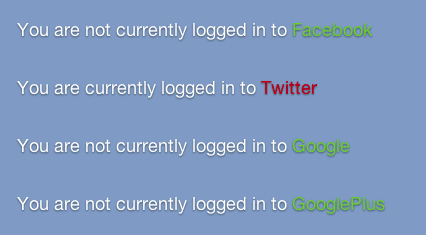 This is a creative implementation that discovers several information flow theory violations. The end result is a website that is not part of a given social network can tell if a connected user is logged into the social network.
Check out the demo to see what your browser reveals.
Thursday, March 1, 2012
Brute Forcing Credit Card Numbers
 PCI Regulations allow merchants to store the first 6 digits plus the last 4 digits of a customer's credit card number. Ever wonder just how secure that is?
Well, without knowing anything else, if a credit card is stored as 1234-56xx-xxxx-1234, the possible missing middle digits range from 00-0000 to 99-9999, roughly one million (1,000,000) possible combinations. That seems very tough to guess (without being detected).
However, credit card numbers all implement Luhn's Algorithm, which is a special mathematical formula that uses the last digit in the number as a check digit. Not all of the 1,000,000 middle combinations will pass Luhn's check. Turns out (since modulus 10 math is involved), the quantity of missing middle number combinations is at most 100,000 possibilities, not a million. Luhn's reduces the complexity by an order of magnitude.
So, what if an attacker can get just one more digit somehow? Well, it's only 10^4 combinations then: 10,000 possibilities. What if they can get two more digits? The math follows this formula: 10 ^ (n-1). Here's the table:
6 digits
|
10 ^5 = 100,000
|
5 digits
|
10^4 = 10,000
|
4 digits
|
10^3 = 1,000
|
3 digits
|
10^2 = 100
|
2 digits
|
10^1 = 10
|
1 digit*
|
10^0 = 1
|
* It makes sense, if you're missing a single digit, Luhn's will help you recover it. That is the purpose of that algorithm originally.
Now, as far as practical applications for abusing the knowledge of Luhn's Algorithm on a PCI acceptably-formatted credit card number are concerned ... 100,000 attempted transactions to brute force a card number by a single merchant will certainly be detected and the merchant's ability to process any transaction will be in jeopardy. So, an attacker with access to a merchant account is probably not a valid threat to model.
For an attacker to attempt to make purchases at varying merchants with this brute force scheme and everything but the middle 6 digits, the attacker will also have to have the billing address and potentially the CVV code. That makes the problem significantly harder. But as the attacker can discover missing digits from the middle six, the problem becomes easier. If the victim is well chosen, and the attacker can do something like shoulder surf at a point of sale machine to visually see and remember a digit or two or three, then the problem gets noticeably easier. If the attacker can do that, the attacker can probably also guess the billing address and name. There's still that pesky CVV code, though (that's another 3 digits which compounds things).
Realistically, though, for an attacker to get that much information on a victim, the victim would probably have to be oblivious or have an extremely large line of credit to make it worthwhile.
For the rest of us, we're fairly safe with the PCI rules of first 6 plus last 4 digits being public knowledge.
Check this out for yourself. Here's the source code for a very simple C# console application that will take whatever first 6 plus last 4 digits you provide it, and churn out all of the possible middle combinations. Here is the inspiration for the C# Luhn's implementation. [Sorry about the code formatting.]
using System;
using System.Linq;
namespace Luhn
{
public class Luhn
{
private static int _middle = -1;
private static int _counter;
private static int _places;
public static void Main(string[] args)
{
if (!args.Any())
{
PrintUsage();
return;
}
var cc = args[0].Replace("-", "").Replace(" ", "").Replace("x", "X");
if (cc.Length != 16)
{
Console.WriteLine("input is not correct length.");
PrintUsage();
return;
}
_places = cc.Length - cc.Replace("X", "").Length;
var limit = Math.Pow(10, _places);
Console.WriteLine("Places: {0}", _places);
Console.WriteLine("Limit: {0}", limit);
while (_middle < limit)
{
var s = FindNext(cc);
if (!PassesLuhnCheck(s)) continue;
Console.WriteLine("Valid: {0}", s);
_counter++;
}
Console.WriteLine("\r\nFound {0} potential matches for {1}", _counter, args[0]);
}
private static void PrintUsage()
{
Console.Write("Usage: luhn.exe [credit card number]\r\n"
+ " in format like 1234-56xx-xxxx-1234\r\n"
+ " or like 1234-5678-xxxx-1234, etc.\r\n\r\n");
}
private static string FindNext(string number)
{
_middle++;
var middle = _middle.ToString();
while (middle.Length < _places)
{
middle = "0" + middle;
}
return (number.Replace(GetPlaceHolder(), middle));
}
private static string GetPlaceHolder()
{
var s = "";
for (var i = 0; i < _places; i++)
{
s += "X";
}
return s;
}
private static bool PassesLuhnCheck(string number)
{
var deltas = new[] { 0, 1, 2, 3, 4, -4, -3, -2, -1, 0 };
var checksum = 0;
var chars = number.ToCharArray();
for (var i = chars.Length - 1; i > -1; i--)
{
var j = chars[i] - 48;
checksum += j;
if (((i - chars.Length) % 2) == 0)
checksum += deltas[j];
}
return ((checksum % 10) == 0);
}
}
}
Wednesday, February 29, 2012
Traveling Light in a Time of Digital Thievery

This sounds exciting, like intrigue for spy fiction:
When Kenneth G. Lieberthal, a China expert at the Brookings Institution, travels to that country, he follows a routine that seems straight from a spy film.He leaves his cellphone and laptop at home and instead brings “loaner” devices, which he erases before he leaves the United States and wipes clean the minute he returns. In China, he disables Bluetooth and Wi-Fi, never lets his phone out of his sight and, in meetings, not only turns off his phone but also removes the battery, for fear his microphone could be turned on remotely. He connects to the Internet only through an encrypted, password-protected channel, and copies and pastes his password from a USB thumb drive. He never types in a password directly, because, he said, “the Chinese are very good at installing key-logging software on your laptop.”
Both China and Russia prohibit travelers from entering the country with encrypted devices unless they have government permission.Here's better advice:
Now, United States companies, government agencies and organizations are doing the same by imposing do-not-carry rules. Representative Mike Rogers, the Michigan Republican who is chairman of the House Intelligence Committee, said its members could bring only “clean” devices to China and were forbidden from connecting to the government’s network while abroad. As for himself, he said he traveled “electronically naked.”and probably the best advice:
McAfee, the security company, said that if any employee’s device was inspected at the Chinese border, it could never be plugged into McAfee’s network again. Ever. “We just wouldn’t take the risk,” said Simon Hunt, a vice president.The cost of doing business in places like that is the cost of "burn devices". The hardware, data, and software on them, should all be thrown away upon exit. Don't risk powering it back on. Like a disposable camera. Send your data in before you leave in-country, and let go of any and all emotional attachment to the hardware.
If China & Russia can do this, so can any other country or, perhaps even a commercial organization, of any substantial size (yes, even the United States can and will snoop on your devices).
DIY Drones
 Do It Yourself Surveillance Drone Aircraft. Why? Because you still can.
Adjust your one-liner: "if
An excerpt explains why:
It is extremely easy to build a drone now that can do not just surveillance but can carry rather large payloads. If you want to see how large some of these planes get, check out this video of a model Airbus A380. I don’t have to spell out the implications of this. I want to have my drone before the government makes them illegal. The US has been fighting such low-tech enemies lately that we haven’t thought through the nature of a world in which lots of people have sophisticated drones, not just other countries but private individuals. One somewhat worrying thing is that virtually all of this equipment comes from China or Taiwan.
Here's a flight video:
Thursday, February 23, 2012
John Nash Crypto Letters
John Nash (inspiration for A Beautiful Mind) wrote letters to the US Government in the 1950s which have recently been de classified and released to the public. Now you can read for yourself how John Nash was essentially 20 years ahead of the world around him in his plans for a cryptographic system.
The questions to ask yourself are: Did the US Government sit on this devised plan? If so, why? If not, how long were they keeping it to themselves before moving on to something better?
One thing can certainly be learned from history: powerful governments and organizations have kept tight lips on the cryptography they use, and stay far ahead of the power curve. Simon Singh covers the topic well in his book: The Code Book. (If this topic is even partially interesting to you, then you should at least read that book, if not buy a copy.) At each step along the way in recorded history, there have been parties wishing to keep their communications confidential, and significant disparities in the technology to do so. Charles Babbage's scheme for breaking the Vigenère Cipher comes to mind.
 classified and released to the public. Now you can read for yourself how John Nash was essentially 20 years ahead of the world around him in his plans for a cryptographic system.
The questions to ask yourself are: Did the US Government sit on this devised plan? If so, why? If not, how long were they keeping it to themselves before moving on to something better?
One thing can certainly be learned from history: powerful governments and organizations have kept tight lips on the cryptography they use, and stay far ahead of the power curve. Simon Singh covers the topic well in his book: The Code Book. (If this topic is even partially interesting to you, then you should at least read that book, if not buy a copy.) At each step along the way in recorded history, there have been parties wishing to keep their communications confidential, and significant disparities in the technology to do so. Charles Babbage's scheme for breaking the Vigenère Cipher comes to mind.
Tuesday, February 7, 2012
Verisign Hacked!

Verisign was breached according to an SEC report (Reuters), yet they report almost no details and act like it's no big deal!
An excerpt from Reuters (emphasis mine):
"Oh my God," said Stewart Baker, former assistant secretary of the Department of Homeland Security and before that the top lawyer at the National Security Agency. "That could allow people to imitate almost any company on the Net."I knew instantly why Baker is a former Assistant Secretary to DHS: because he understands the gravity of a real security incident. Had he not understood, he would probably still be employed at DHS, along with all of the other laughing stocks and poster children for security theater.
Back on topic: Verisign is probably the single largest peddler of SSL certificates and their Certificate Authorities (CAs) are probably used by more browsers and other applications than any other. Talk about all your eggs in one basket! Not to mention their impact on the control of DNS.
In a past life as a customer of Verisign's certificates, I did not like dealing with them. They were arrogant, acted like they had no competitors, and charged exorbitant prices for their certs. That stated, the fact that mum's the word on what could possibly be the single largest breach in internet history is much cause for concern. If their private keys for any of their CA certs, including their intermediary certs, are breached, then anybody could impersonate any site they wish on the web.
First it was RSA being tight lipped on their SecurID breach, and now it's Verisign on who knows what was breached.
In the authentication world, there really only are 2 methodologies: A) hierarchical, or B) web of trust. Public Key Infrastructure (i.e. Certificate Authorities) are hierarchical. Essentially, we all trust a self-appointed few to discern for us who is authentic and who is not. In the web of trust model, that discernment choice is distributed among all the participants. You may chose to trust a website is your bank, you may not. The most common implementation of web of trust is PGP (the protocol, not the PGP company, which is rife with their own history of issues.) The con to web of trust is that your Grandma (or maybe even you) won't know who to trust, so she'll have a hard time setting up her {computer, iPhone, whatever}. In the hierarchical model, you don't have to think, but sometimes not thinking is a bad thing.
...
What can be learned from this?
1) Even the largest internet security giants can fall, and when they fall they hit the ground hard. A large, recognizable brand may not necessarily improve security. Though these incidents do not conclusively prove this, there is reason to believe that these companies present themselves as a treasure trove to their adversaries. They simply house assets of far greater value than what may otherwise be understood. Aligning your business with these high valued assets might be attracting unnecessary attention from web thieves to your business.
2) It is probably time to revisit the web of trust model.
Wednesday, February 1, 2012
DNSCrypt
 This is a very premature response to what I believe is the single best solution to dangers like SOPA, PIPA, and ACTA: DNSCrypt.
To be fair, I don't think DNSCrypt in and of itself would be a solution to draconian "take the free out of internet" laws; however, it's going to be a very necessary component to maximize liberty in the 21st century. It's amazing the web has lasted this long without end-to-end crypto for DNS.
As stated in the link above, DNSCrypt is no replacement for DNSSEC. In fact, the ideal solution would be to rebuild DNS from the ground up using more of a web-of-trust model and completely end-to-end confidential and authenticated channels everywhere, with the ability to determine which "authority" you subscribe to for DNS and with resources listing themselves with as many authorities as they wish to be associated, ending the centralized (yet distributed for availability) control of the web. There's probably no reason to put that much power in the hands of a single entity anyway, and as governments continue on the path they appear to be on, locking down the web, isolated technical solutions will essentially create black markets for essential services like DNS.
For maximum persistence, an ideally liberated DNS solution would also need to float through filters, learning what it can from protocols designed to do so, like bittorrent, IRC, and basically any "cloud service" an enterprise IT Security team would want to block (those online drive storage services always seem to find a way through!).
And ultimately, wide-scale adoption is very necessary. It's excellent to see the inklings of that plan in DNSCrypt. Look at the choice to use ECC to preserve confidentiality. ECC requires low CPU overhead compared to other public key schemes, like RSA encryption, making it perfect for small devices like phones, wireless routers, and other embedded platforms to natively support DNSCrypt. Also important is for large scale providers like OpenDNS to support it. But like so many great technical solutions to problems, market penetration has been the deciding factor what wins out and what doesn't.
Even if DNSCrypt isn't perfect, it's a step in the right direction.
Friday, December 23, 2011
DIY Lock Pick Set

Here's another very interesting post on lock-picking, like making a padlock shim out of soda can: How to make your own lock-picking tools from a windshield wiper. Of course, the skills that come with it, plus the ethics of when it's acceptable to use it, are just as important (if not more).
After you've picked that up, try a copy of Practical Lock Picking: A Physical Penetration Tester's Training Guide or The Complete Book of Locks and Locksmithing.
Tuesday, December 20, 2011
How to Shim Open a Padlock On the Cheap
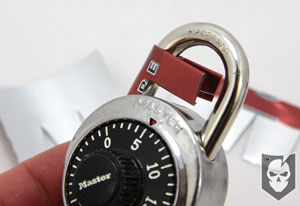 This is a quick, cheap, and simple way to crack open a padlock with a homemade shim from a soda can. Not a new idea, but a well-described set of instructions.
When Professor Matt Blaze published "Safecracking for the Computer Scientist", he received all sorts of negative feedback. There were things in his paper that were known vulnerabilities to all locksmiths for perhaps as long as a century, yet they were not fixed in future designs of locks. Publishing this info does not harm the public, since criminals already know how to do this. But publishing allows consumers of these lock products to be wiser. Master lock (depicted at right) has certainly known about this vulnerability for decades. It's been floating around the internet at least since the dot-com boom days.
Subscribe to:
Posts (Atom)