Showing posts with label crypto. Show all posts

Friday, October 5, 2012

Coping with Compromised Certificate Authorities

With the news containing stories of malware distributing via compromised Certificate Authorities, it makes sense that some IT Security blogs would address "what to do" if this happens to your CA.  This blog post gets it wrong, though:
What would you do if you found out that the Certificate Authority that provides Digital Certificates to your company was compromised, and Microsoft was adding the Certificate Authority’s public key to Windows un-trusted Root Store? Well if you have not got a contingency plan to implement then I can presume you will be in a panic to purchase new certificates from another Certificate Authority... It can take Certificate Authority’s (CA’s) a few days to validate domain ownership and company registration details... While all this is happening your customers are getting a message from Internet Explorer that your SSL certificate is not to be trusted.
What can you do?
  • Do not rely on one Certificate Authority for all of your certificates. You should have a relationship with at least two well known Certificate Authority’s and the CA’s should have validated all of your domains. This will let you quickly order Digital Certificates from the second CA without having to go through the company validation process...
  • If you cannot tolerate any downtime for a service you can take the extra step in which you create backup certificates for each service using your backup Certificate Authority. This will enable you to implement the backup certificates without having to contact the second CA and joining the queue of company’s looking for new certificates.
Keep in mind that the worst-case scenario described above would require the Root CA Certificate to be compromised.  Most Root CAs are offline certs, meaning the computers that house them are not powered on except during special circumstances when new intermediate CA certificates are generated, OR, they are online in an "air gap" (disconnected from the internet) network accessible only via sneakernet.  Exploiting an offline CA is a big deal, and if it occurs it won't be just your organization that is affected, but likely a large part of the entire internet.

So a much more plausible option:
  • The CA will just create a new intermediate CA cert and re-issue client certs to all of its paying customers.
In other words: nothing to see here, please move along.

Monday, August 13, 2012

Hacking Hotels

Breaking into a hotel room with less than $50 in hardware
The technical security media has been all abuzz about a recent Black Hat presentation by Cody Brocious on hacking electronic hotel door locks.

The original author's documentation including the paper and slides are here.

Here's the simplified version:
  • The vendor of the locks has an overwhelming majority of the market in the U.S. (chances are you stayed in a room that had this exact lock on it)
  • The key cards use crypto for implementing the access control
  • The mathematical aspect of the crypto is more or less fine (as is usually the case)
  • The problem comes in managing keys (which is pretty much always the problem!)
  • An administrative feature is easily exploited-- which is only slightly better than vendors shipping products with widely-known default passwords.
  • An administrative maintenance device, when connected, can extract the crypto key and break the access control
  • You can roll-you-own maintenance device on the very, very cheap
  • Yes, this probably looks like a scene in any random Hollywood movie
  • This will likely be a majorly expensive pain to fix for the vendor and hotels
  • "Compensating controls" in this case include surveillance cameras, internal dead bolt manual locks, et al

Wednesday, August 8, 2012

MS-CHAPv2 Crack

It should come as no real surprise: MS-CHAPv2 is broken.  It's an ancient scheme.  If you were paying attention, you would have migrated your VPNs and Wireless networks away from it years ago anyway.

Here's a great break down of what this means to your wireless networks.

An even simpler one is to just note that these combinations are still fine:
  • IPSEC and OpenVPNs are fine.
  • WPA2 Enterprise wireless with PEAP is fine.
  • WPA2 Non-Enterprise (i.e. home) wireless is fine (from this).
And, of course, keep in mind it still takes 24 hours (right now, but that's sure to be sped up) to actually crack the DES encryption key with this exploit.  Since it's 24 hours and not 24 ms, that means an attacker will more than just casually find you and exploit you.  Your network will have to be a target first, at least to some degree.

Saturday, March 31, 2012

Stanford University Online Cryptography Course

Stanford University has a free online Cryptography Course. Looks very interesting for someone who wants to peel back the layers of the onion, but isn't scared off by the math. (Many applied cryptographers aren't necessarily experts in the theoretical mathematical aspects and vice versa.)

Professor Dan Boneh gives an introduction to the course:

Thursday, February 23, 2012

John Nash Crypto Letters

John Nash (inspiration for A Beautiful Mind) wrote letters to the US Government in the 1950s which have recently been deLinkclassified and releasedLink to the public. Now you can read for yourself how John Nash was essentially 20 years ahead of the world around him in his plans for a cryptographic system.

The questions to ask yourself are: Did the US Government sit on this devised plan? If so, why? If not, how long were they keeping it to themselves before moving on to something better?

One thing can certainly be learned from history: powerful governments and organizations have kept tight lips on the cryptography they use, and stay far ahead of the power curve. Simon Singh covers the topic well in his book: The Code Book. (If this topic is even partially interesting to you, then you should at least read that book, if not buy a copy.) At each step along the way in recorded history, there have been parties wishing to keep their communications confidential, and significant disparities in the technology to do so. Charles Babbage's scheme for breaking the Vigenère Cipher comes to mind.

Tuesday, February 7, 2012

Verisign Hacked!


Verisign was breached according to an SEC report (Reuters), yet they report almost no details and act like it's no big deal!

An excerpt from Reuters (emphasis mine):

"Oh my God," said Stewart Baker, former assistant secretary of the Department of Homeland Security and before that the top lawyer at the National Security Agency. "That could allow people to imitate almost any company on the Net."
I knew instantly why Baker is a former Assistant Secretary to DHS: because he understands the gravity of a real security incident. Had he not understood, he would probably still be employed at DHS, along with all of the other laughing stocks and poster children for security theater.

Back on topic: Verisign is probably the single largest peddler of SSL certificates and their Certificate Authorities (CAs) are probably used by more browsers and other applications than any other. Talk about all your eggs in one basket! Not to mention their impact on the control of DNS.

In a past life as a customer of Verisign's certificates, I did not like dealing with them. They were arrogant, acted like they had no competitors, and charged exorbitant prices for their certs. That stated, the fact that mum's the word on what could possibly be the single largest breach in internet history is much cause for concern. If their private keys for any of their CA certs, including their intermediary certs, are breached, then anybody could impersonate any site they wish on the web.

First it was RSA being tight lipped on their SecurID breach, and now it's Verisign on who knows what was breached.

In the authentication world, there really only are 2 methodologies: A) hierarchical, or B) web of trust. Public Key Infrastructure (i.e. Certificate Authorities) are hierarchical. Essentially, we all trust a self-appointed few to discern for us who is authentic and who is not. In the web of trust model, that discernment choice is distributed among all the participants. You may chose to trust a website is your bank, you may not. The most common implementation of web of trust is PGP (the protocol, not the PGP company, which is rife with their own history of issues.) The con to web of trust is that your Grandma (or maybe even you) won't know who to trust, so she'll have a hard time setting up her {computer, iPhone, whatever}. In the hierarchical model, you don't have to think, but sometimes not thinking is a bad thing.

...

What can be learned from this?

1) Even the largest internet security giants can fall, and when they fall they hit the ground hard. A large, recognizable brand may not necessarily improve security. Though these incidents do not conclusively prove this, there is reason to believe that these companies present themselves as a treasure trove to their adversaries. They simply house assets of far greater value than what may otherwise be understood. Aligning your business with these high valued assets might be attracting unnecessary attention from web thieves to your business.

2) It is probably time to revisit the web of trust model.

Wednesday, February 1, 2012

DNSCrypt

This is a very premature response to what I believe is the single best solution to dangers like SOPA, PIPA, and ACTA: DNSCrypt.

To be fair, I don't think DNSCrypt in and of itself would be a solution to draconian "take the free out of internet" laws; however, it's going to be a very necessary component to maximize liberty in the 21st century. It's amazing the web has lasted this long without end-to-end crypto for DNS.

As stated in the link above, DNSCrypt is no replacement for DNSSEC. In fact, the ideal solution would be to rebuild DNS from the ground up using more of a web-of-trust model and completely end-to-end confidential and authenticated channels everywhere, with the ability to determine which "authority" you subscribe to for DNS and with resources listing themselves with as many authorities as they wish to be associated, ending the centralized (yet distributed for availability) control of the web. There's probably no reason to put that much power in the hands of a single entity anyway, and as governments continue on the path they appear to be on, locking down the web, isolated technical solutions will essentially create black markets for essential services like DNS.

For maximum persistence, an ideally liberated DNS solution would also need to float through filters, learning what it can from protocols designed to do so, like bittorrent, IRC, and basically any "cloud service" an enterprise IT Security team would want to block (those online drive storage services always seem to find a way through!).

And ultimately, wide-scale adoption is very necessary. It's excellent to see the inklings of that plan in DNSCrypt. Look at the choice to use ECC to preserve confidentiality. ECC requires low CPU overhead compared to other public key schemes, like RSA encryption, making it perfect for small devices like phones, wireless routers, and other embedded platforms to natively support DNSCrypt. Also important is for large scale providers like OpenDNS to support it. But like so many great technical solutions to problems, market penetration has been the deciding factor what wins out and what doesn't.

Even if DNSCrypt isn't perfect, it's a step in the right direction.

Wednesday, March 23, 2011

RSA SecurID Breach - Seed Record Threats

The following is a threat model that assumes the RSA SecurID seed records have been stolen by a sophisticated adversary, which is probably what happened.

But first, a word from our muse, Bruce Schneier, regarding what he titled back in 2005 as the "Failure of Two Factor Authentication":
Two-factor authentication isn't our savior. It won't defend against phishing. It's not going to prevent identity theft. It's not going to secure online accounts from fraudulent transactions. It solves the security problems we had ten years ago, not the security problems we have today.
[snip]
Here are two new active attacks we're starting to see:
  • Man-in-the-Middle attack. An attacker puts up a fake bank website and entices user to that website. User types in his password, and the attacker in turn uses it to access the bank's real website. Done right, the user will never realize that he isn't at the bank's website. Then the attacker either disconnects the user and makes any fraudulent transactions he wants, or passes along the user's banking transactions while making his own transactions at the same time.
  • Trojan attack. Attacker gets Trojan installed on user's computer. When user logs into his bank's website, the attacker piggybacks on that session via the Trojan to make any fraudulent transaction he wants.
See how two-factor authentication doesn't solve anything? In the first case, the attacker can pass the ever-changing part of the password to the bank along with the never-changing part. And in the second case, the attacker is relying on the user to log in.
[Snip]
Two-factor authentication ... won't work for remote authentication over the Internet.
Bruce was absolutely right. We saw examples of that.

...

Now, let's put the pieces together-- the active MITM attacks that Bruce described, which could result in an offline/passive attack.

In both cases above, the adversary has to act immediately to essentially take over an authenticated session, using either the real-time MITM scenario, or the trojan scenario. But let's assume that the "good guys" have, by now, read Bruce's article [but in all reality, they probably haven't, hence they have an RSA SecurID investment] and have paid attention to the RSA jabber that says to watch for an increase in login attempts. In these examples Bruce describes, the adversary grabs the session and disconnects the valid user (possibly at the presentation layer, by taking over the session in malware that doesn't display what the actions are occurring in the authenticated session).

However, let's assume the adversary let's the user keep his authenticated session. The adversary just monitors the credentials that are entered:
  1. The User ID, and
  2. The one-time-passcode (token's readout, a.k.a. "tokencode", plus the user's PIN)
"Relax," says the security administrator. "That's what these RSA SecurID thingies are for-- to make it meaningless when a bad guy eavesdrops on credentials."

Well, except in the case where the "bad guy" has all of the seed records for all RSA SecurID tokens ever sold.

Quoting from our article from yesterday:
Assume an adversary has now in their possession, all of the seed records for all RSA SecurID tokens that are currently valid (which based on above and previous seems very plausible). Assume they have sufficient computing hardware to mass compute all of the tokencodes for all of the tokens represented by those seed records for a range of time (they obviously are well funded to get the "Advanced Persistent Threat" name). This would be the output of the RSA SecurID algorithm taking all the future units of time as input coupled with the serial number/token codes to generate all of the output "hashes" for each RSA SecurID token that RSA has ever made. These mass computed tokencodes for a given range of time would basically be one big rainbow table, a time computing trade-off not too unlike using rainbow tables to crack password hashes.
[Snip]
Since tokencodes are only 6 digits long, and RSA has sold millions of tokens, the chances of a collision of a token's output with another token's output at a random point in time is significant enough, but phish the same user repeatedly (like asking for "next tokencode") and the adversary now can significantly narrow down the possibilities of which tokens belong to which user because different tokens must appear random and not in sync with each other (otherwise RSA SecurID would have much bigger problems). Do this selectively over a period of time for a high valued asset, and chances are the adversary's presence will go undetected, but the adversary will be able to determine exactly which token (serial number, i.e. seed record) belongs to the victim user.
So, now that the adversary has these "rainbow tables" of RSA SecurID tokencodes, and now that the active attacks Bruce described have morphed into a passive attempt, all it will take is watching particular users create valid sessions-- maybe as little as a single attempt, depending upon the mathematics and randomness of the RSA SecurID token output, but probably more like watching a handful of attempts. At that point, the adversary can then impersonate the victim user at any point in the future.

So, if RSA SecurID seed records are compromised, there is really not much advantage in an RSA SecurID implementation. The threats are essentially the same as an adversary grabbing conventional passwords. The only difference is that a passive attack against compromised seed records may take multiple monitoring attempts, as opposed to a single event. But with simple malware, that won't be much more effort, especially for a high valued asset.

So given what we know, we can assume seed records were compromised. And given how little RSA is talking about it, we cannot really know how they are responding to it. Will they just distribute new tokens without compromised seed records, or will they do something much more significant? Based on what we know today, it makes more sense for an organization that is thinking about an RSA SecurID deployment to rely instead on conventional passwords (e.g. Microsoft Active Directory), and spend the extra money on monitoring for fraud and stronger identity validation for things like password resets.

Tuesday, March 22, 2011

More RSA SecurID Reactions

RSA Released a new Customer FAQ regarding the RSA SecurID breach. Let's break it down ...
Customer FAQ
Incident Overview

1. What happened?

Recently, our security systems identified an extremely sophisticated cyber attack in progress, targeting our RSA business unit. We took a variety of aggressive measures against the threat to protect our customers and our business including further hardening our IT infrastructure and working closely with appropriate authorities.
Glad to see they didn't use the words "Advanced Persistent Threat" there.
2. What information was lost?

Our investigation to date has revealed that the attack resulted in certain information being extracted from RSA’s systems. Some of that information is related to RSA SecurID authentication products.
Hmmm. Seed Records possibly?
3. Why can’t you provide more details about the information that was extracted related to RSA SecurID technology?

Our customers’ security is our number one priority. We continue to provide our customers with all the information they need to assess their risk and ensure they are protected. Providing additional specific information about the nature of the attack on RSA or about certain elements of RSA SecurID design could enable others to try to compromise our customers’ RSA SecurID implementations.
[Emphasis added by Securology]
Whoa! Pause right there. Obviously they have allowed somebody from a Public/Customer Relations background to write this. This is not coming from anybody who *knows security*.

Like we mentioned previously, Kerckhoff's Principle and Shannon's Maxim dictate that the DESIGN be open. These ideas are older than the Internet, and pretty much older than computing itself. So, disclosing the RSA SecurID DESIGN should have no adverse affect on customers with implementations unless the DESIGN is flawed to begin with.

Realistically, this is PR-speak for obfuscating details about what was stolen. All things point to seed records. Source code to on-premise implementations at customer sites shouldn't be affected, because those components aren't facing the Internet, and generally who cares about them? Yes, it's possible to hack the backend through things like XSS (think "Cross Site Printing"), but the state-of-the-art would be to compromise it from the outside using weaknesses found at RSA headquarters: seed records.
4. Does this event weaken my RSA SecurID solution against attacks?

RSA SecurID technology continues to be an effective authentication solution. To the best of our knowledge, whoever attacked RSA has certain information related to the RSA SecurID solution, but not enough to complete a successful attack without obtaining additional information that is only held by our customers. We have provided best practices so customers can strengthen the protection of the RSA SecurID information they hold. RSA SecurID technology is as effective as it was before against other attacks.
[Emphasis added by Securology.]
If it wasn't obvious that it's seed records yet, it should be screaming "SEED RECORDS" by this point. RSA SecurID is a two factor authentication system, meaning you can couple your RSA SecurID time synchronized tokencode with a PIN/Password. So, if the seed records are stolen, then the only way an adversary can impersonate you would be if he knew:
  1. Which RSA SecurID token is assigned to you (i.e. the serial number stored in the RSA SecurID database on-site at a customer's site)
  2. Your PIN/Passcode that is the second facto (i.e. another piece of information stored in the customer's site).
More evidence that the RSA breach was seed records: the serial number and seed records give the adversary half the information needed, but the rest is stored on-site.
5. What constitutes a direct attack on an RSA SecurID customer?

To compromise any RSA SecurID deployment, an attacker needs to possess multiple pieces of information about the token, the customer, the individual users and their PINs. Some of this information is never held by RSA and is controlled only by the customer. In order to mount a successful direct attack, someone would need to have possession of all this information.


6. What constitutes a broader attack on an RSA SecurID customer?

To compromise any RSA SecurID deployment, the attacker needs to possess multiple pieces of information about the token, the customer, the individual users and their PINs. Some of this information is never held by RSA and is controlled only by the customer. In order to mount a successful direct attack, someone would need to have possession of all this information.

The broader attack we referenced most likely would be an indirect attack on a customer that uses a combination of technical and social engineering techniques to attempt to compromise all pieces of information about the token, the customer, the individual users and their PINs. Social engineering attacks typically target customers’ end users and help desks. Technical attacks typically target customers’ back end servers, networks and end user machines. Our prioritized remediation steps in the RSA SecurID Best Practices Guides are focused on strengthening your security against these potential broader attacks.
[Emphasis added by Securology]
This PR person is beginning to agree with us. Yes, the seed records are the hard part. If you are an RSA SecurID customer, assume the adversary has them, and now watch out for the pieces you control.
7. Have my SecurID token records been taken?
[Emphasis added by Securology.]
Yes, it's obvious they have.
For the security of our customers, we are not releasing any additional information about what was taken. It is more important to understand all the critical components of the RSA SecurID solution.

To compromise any RSA SecurID deployment, the attacker needs to possess multiple pieces of information about the token, the customer, the individual users and their PINs. Some of this information is never held by RSA and is controlled only by the customer. In order to mount a successful attack, someone would need to have possession of all this information.
This is beginning to look like a broken record.
8. Has RSA stopped manufacturing and/or distributing RSA SecurID tokens or other products?

As part of our standard operating procedures, while we further harden our environment some operations are interrupted. We expect to resume distribution soon and will share information on this when available.
Of course manufacturing/distribution has stopped. Of course anyone worried about security would have an SOP that says "stop shipping the crypto devices when the seed records are compromised." This is just more evidence that the seed records were compromised.
[...snipped for brevity...]
13. How can I monitor my deployment for unusual authentication activity?

To detect unusual authentication activity, the Authentication Manager logs should be monitored for abnormally high rates of failed authentications and/or “Next Tokencode Required” events. If these types of activities are detected, your organization should be prepared to identify the access point being used and shut them down.

The Authentication Manager Log Monitoring Guidelines has detailed descriptions of several additional events that your organization should consider monitoring.
[Emphasis added by Securology]
Warning about failed authentication and next tokencode events further indicates the seed records were stolen, because this would indicate the adversaries are guessing valid tokencodes but invalid PINs, or guessing tokencodes in order to determine a specific user's serial number (to match stolen seed records with a particular user).
14. How do I protect users and help desks against Social Engineering attacks such as targeted phishing?

Educate your users on a regular basis about how to avoid phishing attacks. Be sure to follow best practices and guidelines from sources such as the Anti-Phishing Working Group (APWG) at http://education.apwg.org/r/en/index.htm.

In addition, make sure your end users know the following:
  • They will never be asked for and should never provide their token serial numbers, tokencodes, PINs, passwords, etc.
Because giving that away is giving away the last parts of information that are "controlled only by the customer", i.e. the mapping of UserIDs to seed records via token serial numbers.
  • Do not enter tokencodes into links that you clicked in an email. Instead, type in the URL of the reputable site to which you want to authenticate
Because a phishing attack that takes a tokencode could be all that is needed to guess which serial number a user has, since that moment in time could be recorded, and all seed records could be used in a parallel, offline attack to compute their token codes at that instance in time. Assume an adversary has now in their possession, all of the seed records for all RSA SecurID tokens that are currently valid (which based on above and previous seems very plausible). Assume they have sufficient computing hardware to mass compute all of the tokencodes for all of the tokens represented by those seed records for a range of time (they obviously are well funded to get the "Advanced Persistent Threat" name). This would be the output of the RSA SecurID algorithm taking all the future units of time as input coupled with the serial number/token codes to generate all of the output "hashes" for each RSA SecurID token that RSA has ever made. These mass computed tokencodes for a given range of time would basically be one big rainbow table, a time computing trade-off not too unlike using rainbow tables to crack password hashes. Then assume the adversaries can phish users into providing a tokencode into a false login prompt. Since tokencodes are only 6 digits long, and RSA has sold millions of tokens, the chances of a collision of a token's output with another token's output at a random point in time is significant enough, but phish the same user repeatedly (like asking for "next tokencode") and the adversary now can significantly narrow down the possibilities of which tokens belong to which user because different tokens must appear random and not in sync with each other (otherwise RSA SecurID would have much bigger problems). Do this selectively over a period of time for a high valued asset, and chances are the adversary's presence will go undetected, but the adversary will be able to determine exactly which token (serial number, i.e. seed record) belongs to the victim user. Or do it in mass quickly (think: social media) and it will harvest many userIDs to serial numbers (seed records) which would be valuable on the black market-- especially for e-commerce banking applications.
It is also critical that your Help Desk Administrators verify the end user’s identity before performing any Help Desk operations on their behalf. Recommended actions include:

· Call the end user back on a phone owned by the organization and on a number that is already stored in the system.

· Send the user an email to a company email address. If possible, use encrypted mail.

· Work with the employee’s manager to verify the user’s identity

· Verify the identity in person

· Use multiple open-ended questions from employee records (e.g., “Name one person in your group” or, “What is your badge number?”). Avoid yes/no questions

Important: Be wary of using mobile phones for identity confirmation, even if they are owned by the company, as mobile phone numbers are often stored in locations that are vulnerable to tampering or social engineering.
[...snipped for brevity...]
The above is very decent advice, not unlike what we posted recently.


So, in summary: yeah, yeah, yeah, seed records were stolen. Little to no doubt about that now.

Friday, March 18, 2011

RSA SecurID Breach - Initial Reactions


RSA, the security division of EMC, was breached by a sophisticated adversary who stole something of value pertaining to RSA SecurID two factor authentication implementations. That much we know for certain.


It's probably also safe to say that RSA SecurID will be knocked at least a notch down off their place of unreasonably high esteem.


And it wouldn't hurt to take this as a reminder that there is no such thing as a perfectly secure system. Complexity wins every time and the adversary has the advantage.


First, note that the original Securology article entitled "Soft tokens aren't tokens at all" is still very valid as the day it was published over 3 years ago. CNET is reporting that RSA has sold 40 million hardware tokens and 250 million software tokens. That means that 86% of all RSA SecurID "tokens" (which are of the "soft token" variety) are already wide open all of the problems that an endpoint device has-- and more importantly, that 86% of the "two factor authentication" products sold and licensed by RSA are not really "two factor authentication" in the first place.


Second, we should note the principles in economics, so eloquently described by your mother as: "don't put all your eggs in one basket", i.e. the principle of diversification. If your organization relies solely on RSA SecurID for security, you were on borrowed time to begin with. For those organizations, this event is just proof that "the emperor hath no clothes".


Third, the algorithm behind RSA SecurID is not publicly disclosed. This should be a red flag to anyone worth their salt in security. This is a direct violation of Kerckhoff's Principle and Shannon's Maxim, roughly that only the encryption keys should be secret and that we should always assume an enemy knows (or can reverse engineer) the algorithm. There have been attempts in the past to reverse engineer the RSA SecurID algorithm, but those attempts are old and not necessarily the way the current version operates.


Fourth, it's probably the seed records that were stolen. Since we know that the algorithm is essentially a black box, taking as input a "seed record" and the current time, then either disclosure of the "seed records" or disclosure of the algorithm could potentially be devastating to any system relying on RSA SecurID for authentication.

Hints that the "seed records" were stolen can be seen in this Network World article:
But there's already speculation that attackers gained some information about the "secret sauce" for RSA SecurID and its one-time password authentication mechanism, which could be tied to the serial numbers on tokens, says Phil Cox, principal consultant at Boston-based SystemExperts. RSA is emphasizing that customers make sure that anyone in their organizations using SecurID be careful in ensuring they don't give out serial numbers on secured tokens. RSA executives are busy today conducting mass briefings via dial-in for customers, says Cox. [emphasis added by Securology]
Suggesting to customers to keep serial numbers secret implies that seed records were indeed stolen.

When a customer deploys newly purchased tokens, the customer must import a file containing a digitally signed list of seed records associated with serial numbers of the device. From that point on, administrators assign a token by serial number, which is really just associating the seed record of the device with the user's future authentication attempts. Any time that user attempts to authenticate, the server takes the current time and the seed record and computes its own tokencode for comparison to the user input. In fact, one known troubleshooting problem happens when the server and token get out of time synchronization. NTP is usually the answer to that problem.

This further strengthens the theory that seed records were stolen by the "advanced persistent threat", since any customer with a copy of the server-side components essentially has the algorithm, through common reversing techniques of binaries. The server's CPU must be able to computer the tokencode via the algorithm, therefore monitoring instructions as they enter the CPU will divulge the algorithm. This is not a new threat, and certainly nothing worthy of a new moniker. The most common example of reversing binaries is for bypassing software licensing features-- it doesn't take a world-class threat to do that. What is much, much more likely is that RSA SecurID seed records were indeed stolen.

The only item of value that could be even more damaging might be the algorithm RSA uses to establish seed records and associate them with serial numbers. Assuming there is some repeatable process to that-- and it makes sense to believe there is since that would make production manufacturing of those devices more simple-- then stealing that algorithm is like stealing all seed records: past, present, and future.

Likewise, even if source code is the item that was stolen, it's unlikely that any of that will translate into real attacks since most RSA SecurID installations do not directly expose the RSA servers to the Internet. They're usually called upon by end-user-facing systems like VPNs or websites, and the Internet tier generally packages up the credentials and passes them along in a different protocol, like RADIUS. The only way a vulnerability in the stolen source code would become very valuable would be if there is an injection vulnerability found in it, such as passing a malicious input in a username and password challenge that resulted in the back-end RSA SecurID systems to fail open, much like a SQL injection attack. It's possible, but much more probable that seed records were the stolen item of value.


How to Respond to the News
Lots of advice has been shared for how to handle this bad news. Most of it is good, but a couple items need a reality check.


RSA filed with the SEC and in their filing there is a copy of their customer support note on the issue. At the bottom of the form, is a list of suggestions:
  • We recommend customers increase their focus on security for social media applications and the use of those applications and websites by anyone with access to their critical networks.
  • We recommend customers enforce strong password and pin policies.
  • We recommend customers follow the rule of least privilege when assigning roles and responsibilities to security administrators.
  • We recommend customers re-educate employees on the importance of avoiding suspicious emails, and remind them not to provide user names or other credentials to anyone ...
  • We recommend customers pay special attention to security around their active directories, making full use of their SIEM products and also implementing two-factor authentication to control access to active directories.
  • We recommend customers watch closely for changes in user privilege levels and access rights using security monitoring technologies such as SIEM, and consider adding more levels of manual approval for those changes.
  • We recommend customers harden, closely monitor, and limit remote and physical access to infrastructure that is hosting critical security software.
  • We recommend customers examine their help desk practices for information leakage that could help an attacker perform a social engineering attack.
  • We recommend customers update their security products and the operating systems hosting them with the latest patches.
[emphasis added by Securology]

Unless RSA is sitting on some new way to shim into the Microsoft Active Directory (AD) authentication stacks (and they have not published it), there is no way to accomplish what they have stated there in bold. AD consists of mainly LDAP and Kerberos with a sprinkling in of a few other neat features (not going into those for brevity). LDAP/LDAPS (the secure SSL/TLS version) and Kerberos are both based on passwords as the secret to authentication. They cannot simply be upgraded into using two-factor authentication.

Assuming RSA is suggesting installing the RSA SecurID agent for Windows on each Domain Controller in an AD forest, that still does not prevent access to making changes inside of AD Users & Computers, because any client must be able to talk Kerberos and LDAP to at least a single Domain Controller for AD's basic interoperability to function-- those same firewall rules for those services will also allow authenticated and authorized users to browse and modify objects within the directory. What they're putting in there just doesn't seem to be possible and must have been written by somebody who doesn't understand the Microsoft Active Directory product line very well.


Securosis has a how-to-respond list on their blog:
Remember that SecurID is the second factor in a two-factor system… you aren’t stripped naked (unless you’re going through airport security). Assuming it’s completely useless now, here is what you can do:
  1. Don’t panic. We know almost nothing at this point, and thus all we can do is speculate. Until we know the attacker, what was lost, how SecurID was compromised (if it is), and the vector of a potential attack we can’t make an informed risk assessment.
  2. Talk to your RSA representative and pressure them for this information.
  3. Assume SecureID is no longer effective. Review passwords tied to SecurID accounts and make sure they are strong (if possible).
  4. If you are a high-value target, force a password change for any accounts with privileges that could be overly harmful (e.g. admins).
  5. Consider disabling accounts that don’t use a password or PIN.
  6. Set password attempt lockouts (3 tries to lock an account, or similar).
[Emphasis added by Securology]
To their first point, I think we can know what was lost: seed records. Without that, there would be no point in filing with the SEC and publicly disclosing that fact. Anybody can know their algorithm for computing one-time passwords by reversing the server side (see above). The only other component in the process is the current time, which is public information. The only private information is the seed record.

On point #4, if your organization is a high-valued asset type of a target, flagging RSA SecurID users to change their PINs or passwords associated with their user accounts may not be a good idea, because as the defense you have to assume this well articulated offensive adversary already has your seed records and therefore could respond to the challenge to reset passwords. A better solution, if your organization is small, is to physically meet with and reset credentials for high valued users. If you cannot do that because your organization is too large of a scale, then your only real option is to monitor user behavior for abnormalities-- which is where most of your true value should come from anyway.

This does tie well with their second suggestion-- pressuring your RSA contact for more information. In all likelihood, if our speculation that seed records were indeed stolen, then the only solution is to demand new RSA SecurID tokens from RSA to replace the ones you have currently. And if RSA is not quick to respond to that, it's for one of two reasons:
  1. This is going to financially hurt them in a very significant way and it's not easy to just mass produce 40 million tokens overnight, OR,
  2. RSA's algorithm for generating seed records and assigning them to token serial numbers is compromised, and they're going to need some R&D time to come up with a fix without breaking current customers who order new tokens under the new seed record generation scheme in the future.

UPDATED TO ADD: Since all things indicate the seed records were compromised, and since Art Coviello's message is that no RSA customers should have reduced security as a result of their breach, then that must mean RSA does not believe SecurID is worth the investment. After all, if RSA SecurID seed records were stolen, it effectively reduces any implementation to just a single factor: the PIN/passwords that are requested in addition to the tokencode. And who would buy all that infrastructure and handout worthless digital keychains when they can get a single factor password authentication for super cheap with Microsoft's Active Directory?

Thursday, July 1, 2010

Schneier vs PCI

Bruce Schneier just echoed what I wrote back in December 2008 that the encryption key management aspects of PCI 1.2 and earlier are flat-out, numb-skull retarded.

Here's an excerpt of what I said:
What the authors of the DSS were thinking was that PCI compliant merchants would implement cold war-esque missile silo techniques in which two military officers would each place a physical key into a control console and punch in their portion of the launch code sequence. This is technically possible to do with schemes like Adi Shamir's key splitting techniques. However, it rarely makes sense to do so.

Consider an automated e-commerce system. The notion of automation means it works on its own, without human interaction. If that e-commerce system needs to process or store credit card numbers, it will need to encrypt and decrypt them as transactions happen. In order to do those cryptographic functions, the software must have access to the encryption key. It makes no sense for the software to only have part of the key or to rely on a pair of humans to provide it a copy of the key. That defeats the point of automation.

If the pieces of the key have to be put together for each transaction, then a human would have to be involved with each transaction-- definitely not worth the expense! Not to mention an exploit of a vulnerability in the software could result in malicious software keeping a copy of the full key once it's unlocked anyway (because it's the software that does the crypto functions, not 2 people doing crypto in their heads or on pen and paper!).

If a pair of humans are only involved with the initial unlocking of the key, then the software gets a full copy of the key anyway. Any exploit of a vulnerability in the software could potentially read the key, because the key is in its running memory. So, on the one hand, there is no requirement for humans to be involved with each interaction, thus the e-commerce system can operate more cheaply than, say, a phone-order system or a brick-and-mortar retailer. However, each restart of the application software requires a set of 2 humans to be involved with getting the system back and online. Imagine the ideal low-overhead e-commerce retailer planning vacation schedules for its minimal staff around this PCI requirement! PCI essentially dictates that more staff must be hired! Or, that support staff that otherwise would NOT have access to a portion of the key (because they take level 1 calls or work in a different group) now must be trusted with a portion of it. More hands involved means more opportunity for collusion, which increases the risk by increasing the likelihood of an incident, which is NOT what the PCI folks are trying to accomplish!

The difference between a cold war missile silo and an e-commerce software application is the number of "secure" transactions each must have. Missile silos do not launch missiles at the rate of several hundred to several thousand an hour, but good e-commerce applications can take that many credit cards. When there are few (albeit more important) transactions like entering launch codes, it makes sense to require the attention of a couple different people.

So splitting the key such that an e-commerce software application cannot have the full key is stupid.
Here's an excerpt of what Bruce said:
Let's take a concrete example: credit card databases associated with websites. Those databases are not encrypted because it doesn't make any sense. The whole point of storing credit card numbers on a website is so it's accessible -- so each time I buy something, I don't have to type it in again. The website needs to dynamically query the database and retrieve the numbers, millions of times a day. If the database were encrypted, the website would need the key. But if the key were on the same network as the data, what would be the point of encrypting it? Access to the website equals access to the database in either case. Security is achieved by good access control on the website and database, not by encrypting the data.
It's nice to be validated from time to time, especially from the best.

Friday, May 21, 2010

Verisign Turns Yellow

On the heels of turning PGP corp Yellow, now Verisign is turning Yellow, too. Symantec is acquiring Verisign, too.

These overpriced "security solutions" are going to go from bad to worse. I predict agile startups are going to crush them on their prices, since Symantec's goal is obviously to own the entire market with a one-size-fits-all approach, while some startups and smaller companies will probably better understand their customers' needs.

It's ironic how the PGP (distributed) model once fought strongly against the PKI (hierarchical, centralized) model. But now, thanks to deep pockets at Big Yellow, they'll be wearing the same uniform.

SSL and crypto are now commodities, so where are the commodity prices from PGP Corp, Verisign, and Symantec? Simple: they won't have them on their pricing lists.

I've ranted many times about both companies. PGP tries to sell you goods they admit won't solve the problems they're designed for (the "all bets are off when you lose physical control of the device" excuse). And Verisign tries to double-dip on premium "Extended Validation" SSL certs, ignoring their culpability in Certificate Authorities granting SSL certificates to frauds and phishers-- they want you to pay extra for their mistakes.

Do us all a favor and use open source or support their competitors who have true commodity prices.

Wednesday, December 2, 2009

The Reality of Evil Maids

There have been many attacks on whole disk encryption recently:
  1. Cold Boot attacks in which keys hang around in memory a lot longer than many thought, demonstrating how information flow may be more important to watch than many acknowledge.
  2. Stoned Boot attacks in which a rootkit is loaded into memory as part of the booting process, tampering with system level things, like, say, whole disk encryption keys.
  3. Evil Maid attacks in which Joanna Rutkowska of Invisible Things Lab suggests tinkering with the plaintext boot loader. Why is it plain text if the drive is encrypted? Because the CPU has to be able to execute it, duh. So, it's right there for tampering. Funny thing: I suggested tampering with the boot loader as a way to extract keys way back in October of 2007 when debating Jon Callas of PGP over their undocumented encryption bypass feature, so I guess that means I am the original author of the Evil Maid attack concept, huh?

About all of these attacks, Schneier recently said:
This attack exploits the same basic vulnerability as the "Cold Boot" attack from last year, and the "Stoned Boot" attack from earlier this year, and there's no real defense to this sort of thing. As soon as you give up physical control of your computer, all bets are off.
"As soon as you give up physical control of your computer, all bets are off"??? Isn't that the point of these encryption vendors (Schneier is on the technical advisory board of PGP Corp-- he maybe doesn't add that disclaimer plainly enough). Sure enough, that's the opposite of what PGP Corp claims: "Data remains secure on lost devices." Somebody better correct those sales & marketing people to update their powerpoint slides and website promotions.

To put this plainly: if you still believe that whole disk encryption software is going to keep a skilled or determined adversary out of your data, you are sadly misled. We're no longer talking about 3 letter government agencies with large sums of tax dollars to throw at the problem-- we're talking about script kiddies being able to pull this off. (We may not quite be at the point where script kiddies can do it, but we're getting very close.)

Whole Disk Encryption software will only stop a thief who is interested in the hardware from accessing your data and that thief may not even be smart enough to know how to take a hard drive out of a laptop and plug it into another computer in the first place. You had better hope that thief won't sell it on ebay to somebody who is more interested in data than hardware.

Whole Disk Encryption fails to deliver what it claims. If you want safe data, you need to keep as little of it as possible on any mobile devices that are easily lost or stolen. Don't rely on magic crypto fairy dust and don't trust anyone who spouts the odds or computation time required to compute a decryption key. It's not about the math; it's about the keys on the endpoints.

Trusted Platform Modules (TPMs) (like what Vista can be configured to use) hold out some hope, assuming that somebody cannot find a way to extract the keys out of them by spoofing a trusted bootloader. After all, a TPM is basically just a blackbox: you give it an input (a binary image of a trusted bootloader, for example) and it gives you an output (an encryption key). Since TPMs are accessible over a system bus, which is shared among all components, it seems plausible that a malicious device or even device driver could be used to either make a copy of the key as it travels back across the system bus, OR, that a malicious device could just feed it the proper input (as in not by booting the bootloader but by booting an alternative bootloader and then feeding it the correct binary image) to retrieve the output it wants.

Monday, October 5, 2009

RSA doesn't know Kerckhoff

I found this in RSA Security's guide for their Authentication Manager (a.k.a. RSA SecurID) application suite:
"This reference guide is meant only for security administrators and trusted personnel.
Do not make it available to the general user population."
So much for Kerckhoff's Principle from the world's leading cryptography vendor:
"[S]tated by Auguste Kerckhoffs in the 19th century: a cryptosystem should be secure even if everything about the system, except the key, is public knowledge."

Friday, May 15, 2009

PCI & Content Delivery Networks

Here's an interesting, but commonly overlooked, little security nugget.

If you are running an e-commerce application and rely on a Content Delivery Network (CDN), such as Akamai, beware how your customers' SSL tunnels start and stop.

I came across a scenario in which an organization-- who has passed several PCI Reports on Compliance (RoCs)-- used Akamai as a redirect for their www.[companyname].com e-commerce site. Akamai does their impressive geographical caching stuff by owning the "www" DNS record and responding with an IP based on where you are. They do great work. The organization hosts the web, application, and database servers in a state-of-the-art, expensive top five hosting facility. Since it's known that credit card data passes through the web, app, and database tiers, the organization has PCI binding language in their contract with the hosting provider, which requires the hosting provider to do the usual littany to protect credit cards (firewalls, IDS, biometrics-- must have a note from your mom before you can set foot on-site, that sort of thing). And the organization with the goods follows all appropriate PCI controls, obviously, as they have passed their RoC year after year since the origin of PCI.

Funny thing ... it wasn't until some questions came out about how SSL (TLS) really works under the hood before a big, bad hole was discovered. One of the IT managers was pursuing the concept of Extended Validation certs (even though EV certs are a stupid concept), and an "engineer" (use that term laughingly) pointed out that if they purchased the fancy certs and put them on the webservers in at the hosting provider, they would fail to turn their customers' address bars green. Why? Because of the content delivery network.

You see, SSL/TLS happens in the OSI model before HTTP does. That means a customer who wants to start an encrypted tunnel with "www.somecompany.com" must first look up the DNS entry, then attempt SSL/TLS with them over TCP port 443. This is important: the browser does NOT say "Hey, I want 'www.somecompany.com', is that you? Okay ... NOW ... let's exchange keys and start a tunnel."

In this case, as Akamai hosts the "www" record for "somecompany.com", Akamai must be ready for HTTPS calls into their service. "But wait ... " (you're thinking) " ... Akamai just delivers static content like images or resource files. How can they handle the unique and dynamic behaviors of the application which is required on the other end of the SSL/TLS tunnel?" The answer to your question is: They can't.

On the one hand, the CDN could refuse to accept traffic on port 443 or just refuse to handshake SSL/TLS requests. But that would break transactions into your "https://www.somecompany.com" URLs.

On the other hand, the CDN could accept your customers' HTTPS requests, then serve as a proxy between your customers and your hosting providers' web servers. The entire transactions could be encrypted using HTTPS. But the problem is the CDN must act as a termination point for your customers' requests-- they must DECRYPT those requests. Then they pass those messages back to the hosting provider using a new-- and separate-- HTTPS tunnel.

Guess which option CNDs choose? That's right-- they don't choose to break customers HTTPS attempts. They proxy them. And how did this particular organization figure that out? Well, because an EV-SSL cert on their web server is never presented to their customer. The address bar stays the boring white color, because the customer sees the CDN's certificate, not the organization's.

Why is this statistically relevant? Because a malicious CDN-- or perhaps a malicious employee at a CDN-- could eavesdrop on their HTTPS proxies and save copies of your customers' credit card numbers (or any other confidential information) for their own benefit. The CDN gets to see the messages between the clients and the servers even if only for an instant-- the classic man-in-the-middle attack. An instant is long enough for a breach to occur.

The moral of this story? 1) Learn how the OSI model works. 2) Don't overlook anything. 3) PCI (or any other compliance regulation for that matter) is far from perfect.

Tuesday, February 3, 2009

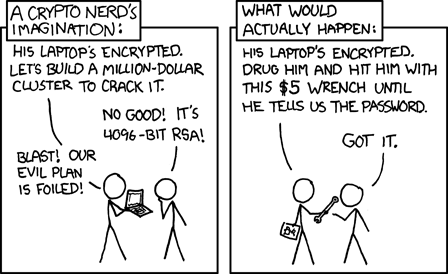
Rubber Hose Cryptanalysis

Rubber hose cryptanalysis, xkcd-style. It's funny because it's true:

Unfortunately, so much of computer security is exactly this way. If the asset is of significant value, the bad guys won't fight fair (they'll fight bits with bats).

Tuesday, December 30, 2008

Forging RSA-MD5 SSL Certs

Wow. This is a big deal:
The forged certificates will say they were issued by a CA called "Equifax Secure Global eBusiness", which is trusted by the major browsers. The forged certificates will be perfectly valid; but they will have been made by forgers, not by the Equifax CA.
To do this, the researchers exploited a cryptographic weakness in one of the digital signature methods, "MD5 with RSA", supported by the Equifax CA. The first step in this digital signature method is to compute the hash (strictly speaking, the cryptographic hash) of the certificate contents.
The hash is a short (128-bit) code that is supposed to be a kind of unique digest of the certificate contents. To be secure, the hash method has to have several properties, one of which is that it should be infeasible to find a collision, that is, to find two values A and B which have the same hash.
It was already known how to find collisions in MD5, but the researchers improved the existing collision-finding methods, so that they can now find two values R and F that have the same hash, where R is a "real" certificate that the CA will be willing to sign, and F is a forged certificate. This is deadly, because it means that a digital signature on R will also be a valid signature on F -- so the attacker can ask the CA to sign the real certificate R, then copy the resulting signature onto F -- putting a valid CA signature onto a certificate that the CA would never voluntarily sign.
Browsers rarely get their list of approved CA certs modified throughout the course of their lives. Most people don't know how to change those, let alone why they should. In Firefox 3, the CA can be removed by going to Preferences > Advanced > Encryption > View Certificates > Authorities > Select the certificate and click delete. I assume the CA cert in question is the one with the following foot print, but cannot say for certain (since it has yet to be published):
8F:5D:77:06:27:C4:98:3C:5B:93:78:E7:D7:98:CC
The question is how to respond to this. There are many CAs that use RSA-MD5 instead of RSA-SHA1. Ripping them from the CA list is probably a good idea, even if it breaks a few web apps. If you are the admin of an e-commerce site using a cert issued by one of these RSA-MD5 CAs, you should probably: 1) Ask for your money back and switch to a different CA, 2) Ask for a new cert issued by an RSA-SHA1 CA, or 3) Forego the purchased certs in lieu of new RSA-SHA1 issued certs, probably in that order of effectiveness.
It is interesting to see a practical attack with MD5 collisions, though. Many people thought they weren't likely.
UPDATED: More info here, too.

Saturday, August 23, 2008

Gmail Mobile Insecurity

Google just released a new set of security features for Gmail. However, you cannot turn on the "always use HTTPS" option if you are also using the older java based Gmail Mobile client for smart phones, like the Blackberry. They have written that app to always fetch new mail and post actions like delete and archive over HTTP instead of HTTPS. With Gmail's new require-HTTPS feature enabled, the mobile client will error out that it cannot fetch mail. The new version (2.0.5 as of right now), is a little quirky with this setting, but it will work with require-HTTPS enabled.

Without the new version, smart phones which can fetch content over local WiFi have a ready made attack vector. Blackberries, which route all traffic through an encrypted tunnel back to the company's BES (Blackberry Enterprise Server), would find themselves vulnerable to eavesdropping and MITM closer to the BES (i.e. the corporate LAN), or, of course, at any hop along the way from the corporate LAN through the ISPs (but ISPs would never snoop on your email ;).

With these embedded devices, how many people stop to think about which protocols these apps use under the hood? It's not like on a traditional browser, where the user can at least monitor link destinations via a status bar. I would also venture to say that not too many people worry about keeping app versions up to date-- there haven't been too many nagging update applications for the majority of smart phones, yet. Google's Mobile Updater requires the user to go in and manually check for new versions. So, it's even more imperative for these app developers to get it right the first time.

Gmail Notifier is also experiencing similar issues.

Friday, May 23, 2008

PCI Silverbullet for POS?

Has Verifone created a PCI silverbullet for Point Of Sale (POS) systems with their VeriShield Protect product? It's certainly interesting. It claims to encrypt credit card data BEFORE it enters POS, passing a similarly formatted (16 digit) encrypted card number into POS that presumably only your bank can decrypt and process.


I have to admit, I like the direction it's headed in. Any organization's goal (unless you are a payment processor) should be to reduce your PCI scope as much as possible, not try to bring PCI to your entire organization. This is a perfectly viable option to addressing risk that is often overlooked: ditch the asset. If you cannot afford to properly protect an asset, and you can find a way to not have to care for the asset anymore, then ditch it.

The questions I have about this specific implementation that are certainly going to have to be answered before anyone can use this to get a PCI QSA off of their back are:

1) What cryptographers have performed cryptanalysis on this "proprietary" design? Verifone's liberty to mingle the words "Triple DES" into their own marketing buzz format, "Hidden TDES", should at least concern you, if you know anything about the history of information security and the track records of proprietary encryption schemes. Since the plaintext and the ciphertext are exactly 16 digits (base 10) long and it appears that only the middle 6 digits are encrypted (see image below), this suggests that there might exist problems with randomness and other common crypto attacks. Sprinkle in the fact that credit card numbers must comply with the "Mod 10" rule (Luhn alogirthm), and I'm willing to bet a good number theorist could really reduce the possibilities of the middle 6 digits. If only the middle 6 digits are encrypted, and they have to be numbers between 0 and 9, then the probability of guessing the correct six digit number is one in a million. But the question is (and it's up to a mathematician or number theorist to answer), how many of the other 999,999 combinations of middle 6 digits, when combined with the first 6 and last 4 digits, actually satisfy the Mod 10 rule? [Especially since the "check digit" in the mod 10 credit card number rule is digit 14, which this method apparently doesn't encrypt.] I'm no mathematician, but I'm willing to bet significantly fewer than 999,999 satisfy the mod 10 rule. It's probably a sizeable cut-down on the brute-force space. If there are any other mistakes in the "H-TDES" design or implementation, it might be even easier to fill in the middle 6 gap.

It would be great to know that Verifone's design was open and peer-reviewed, instead of proprietary. I'd be very curious for someone like Bruce Schneier or Adi Shamir to spend some time reviewing it.


2) How are the keys generated, stored, and rotated? I certainly hope that all of these devices don't get hardcoded (eeprom's flashed) with a static shared key (but I wouldn't be surprised if they are). It would be nice to see something like a TPM (secure co-processor) embedded in the device. That way, we'd know there is an element of tamper resistance. It would be very bad if a study like the one the Light Blue Touchpaper guys at Cambridge University just published would detail that all of the devices share the same key (or just as bad, if all of the devices for a given retailer or bank share the same key).

It would be great if each device had its own public keypair and generated a session key with the bank's public key. This could be possible if the hardware card-swipe device sent the cardholder data to the bank directly instead of relying on a back office system to transmit it (arguably the back-end could do the transmission, provided the card swipe had access to generate a session key with the bank directly).

3) Will the PCI Security Council endorse a solution like this? (Unfortunately, this is probably the most pressing question on most organizations' minds.) If this does not take the Point of Sale system out of PCI scope, then most retailers will not embrace the solution. If the PCI Security Council looks at this correctly with an open mind, then they will seek answers to my questions #1 and #2 before answering #3. In theory, if the retailer doesn't have knowledge or possession of the decryption keys, POS would not be in PCI scope any more than the entire Internet is in PCI scope for e-tailers who use SSL.

...

Many vendors (or more accurately "payment service providers") are using "tokenization" of credit card numbers to get the sticky numbers out of e-tailers' databases and applications, which is a similar concept for e-commerce applications. A simple explanation of tokenizing a credit card number is simply creating a surrogate identifier that means nothing to anyone but the bank (service provider) and the e-tailer. The token replaces the credit card number in the e-tailer's systems, and in best-case scenarios the e-tailer doesn't even touch the card for a millisecond. [Because even a millisecond is long enough to be rooted, intercepted, and defrauded; the PCI Security Council knows that.]

It's great to see people thinking about solutions that fit the mantra: "If you don't have to keep it, then don't keep it."

[Note: all images are likely copyrighted by Verifone and are captures from their public presentation in PowerPoint PPS format here.]

...
[Updated May 23, 2008: Someone pointed out that PCI only requires the middle 6 digits (to which I refer in "question 1" above) to be obscured or protected according to requirement 3.3: "Mask PAN when displayed (the first six and last four digits are the maximum number of digits to be displayed)." Hmmm... I'm not sure how that compares to the very next requirement (3.4): "Render PAN [Primary Account Number], at minimum, unreadable anywhere it is stored" Looks like all 16 digits need to be protected to me.]