The uninstallation program for Symantec Anti-Virus requires an administrator password that is utterly trivial to bypass. This probably isn't new for a lot of people. I always figured this was weak under the hood, like the password was stored in plaintext in a configuration file or registry key, or stored as a hash output of the password that any admin could overwrite with their own hash. But it turns out it's even easier than that. The smart developers at Symantec were thoughtful enough to have a configuration switch to turn off that pesky password prompt altogether. Why bother replacing a hash or reading in a plaintext value when you can just flip a bit to disable the whole thing?
Just flip the bit from 1 to 0 on the registry value called UseVPUninstallPassword at HKEY_LOCAL_MACHINE\SOFTWARE\INTEL\LANDesk\VirusProtect6\ CurrentVersion\Administrator Only\Security. Then re-run the uninstall program.
I am aware of many large organizations that provide admin rights to their employees on their laptops, but use this setting as a way to prevent them from uninstalling their Symantec security products. Security practitioners worth their salt will tell you that admin rights = game over. This was a gimmick of a feature to begin with. What's worse is that surely at least one developer at Symantec knew that before the code was committed into the product, but security vendors have to sell out and tell you that perpetual motion is possible so you'll spend money with them. These types of features demonstrate the irresponsibility of vendors (Symantec) who build them.
And if you don't think a user with admin rights will do this, how trivial would it be for drive-by malware executed by that user to do this? Very trivial.
Just another example on the pile of examples that security features do not equal security.
Thursday, May 28, 2009


Friday, May 15, 2009
"Application" vs "Network" Penetration Tests
Just my two cents, but if you have to dialog about the distinction between an "application" and "network" penetration test, then you're missing the point and not probably testing anything worthwhile.
First of all, the "network" is not an asset. It's a connection medium. Access to a set of cables and blinky lights means nothing. It's the data on the systems that use the "network" that are the assets.
Second, when a pen tester says they're doing a "network penetration test", they really mean they're going to simulate an attacker who will attack a traditional application-- a "canned" application (usually), like one that runs as a service out of the box on a consumer Operating System. It's more than just an authentication challenge (though it could be that). It's likely looking for software defects in those canned applications or commonly known insecure misconfigurations, but it's really still an application that they are testing. [In fact, the argument that a "network penetration test" is nothing more than vulnerability scan seems plausible to me.]
Third, when they say "application penetration test", they are typically talking about either custom software applications or at least an application that didn't come shipped with the OS.
Fourth, if you're trying to test how far one can "penetrate" into your systems to gain access to data, there should be no distinction. If a path to the asset you're trying to protect is through a service that comes bundled with a commercial OS, or if the path to the asset is through a customer product; it makes no difference. A penetration is a penetration.
Yet, as an industry, we like to perpetuate stupidity. This distinction between "network" and "application" penetration tests is such a prime example.
First of all, the "network" is not an asset. It's a connection medium. Access to a set of cables and blinky lights means nothing. It's the data on the systems that use the "network" that are the assets.
Second, when a pen tester says they're doing a "network penetration test", they really mean they're going to simulate an attacker who will attack a traditional application-- a "canned" application (usually), like one that runs as a service out of the box on a consumer Operating System. It's more than just an authentication challenge (though it could be that). It's likely looking for software defects in those canned applications or commonly known insecure misconfigurations, but it's really still an application that they are testing. [In fact, the argument that a "network penetration test" is nothing more than vulnerability scan seems plausible to me.]
Third, when they say "application penetration test", they are typically talking about either custom software applications or at least an application that didn't come shipped with the OS.
Fourth, if you're trying to test how far one can "penetrate" into your systems to gain access to data, there should be no distinction. If a path to the asset you're trying to protect is through a service that comes bundled with a commercial OS, or if the path to the asset is through a customer product; it makes no difference. A penetration is a penetration.
Yet, as an industry, we like to perpetuate stupidity. This distinction between "network" and "application" penetration tests is such a prime example.
PCI & Content Delivery Networks
Here's an interesting, but commonly overlooked, little security nugget.
If you are running an e-commerce application and rely on a Content Delivery Network (CDN), such as Akamai, beware how your customers' SSL tunnels start and stop.
I came across a scenario in which an organization-- who has passed several PCI Reports on Compliance (RoCs)-- used Akamai as a redirect for their www.[companyname].com e-commerce site. Akamai does their impressive geographical caching stuff by owning the "www" DNS record and responding with an IP based on where you are. They do great work. The organization hosts the web, application, and database servers in a state-of-the-art, expensive top five hosting facility. Since it's known that credit card data passes through the web, app, and database tiers, the organization has PCI binding language in their contract with the hosting provider, which requires the hosting provider to do the usual littany to protect credit cards (firewalls, IDS, biometrics-- must have a note from your mom before you can set foot on-site, that sort of thing). And the organization with the goods follows all appropriate PCI controls, obviously, as they have passed their RoC year after year since the origin of PCI.
Funny thing ... it wasn't until some questions came out about how SSL (TLS) really works under the hood before a big, bad hole was discovered. One of the IT managers was pursuing the concept of Extended Validation certs (even though EV certs are a stupid concept), and an "engineer" (use that term laughingly) pointed out that if they purchased the fancy certs and put them on the webservers in at the hosting provider, they would fail to turn their customers' address bars green. Why? Because of the content delivery network.
You see, SSL/TLS happens in the OSI model before HTTP does. That means a customer who wants to start an encrypted tunnel with "www.somecompany.com" must first look up the DNS entry, then attempt SSL/TLS with them over TCP port 443. This is important: the browser does NOT say "Hey, I want 'www.somecompany.com', is that you? Okay ... NOW ... let's exchange keys and start a tunnel."
In this case, as Akamai hosts the "www" record for "somecompany.com", Akamai must be ready for HTTPS calls into their service. "But wait ... " (you're thinking) " ... Akamai just delivers static content like images or resource files. How can they handle the unique and dynamic behaviors of the application which is required on the other end of the SSL/TLS tunnel?" The answer to your question is: They can't.
On the one hand, the CDN could refuse to accept traffic on port 443 or just refuse to handshake SSL/TLS requests. But that would break transactions into your "https://www.somecompany.com" URLs.
On the other hand, the CDN could accept your customers' HTTPS requests, then serve as a proxy between your customers and your hosting providers' web servers. The entire transactions could be encrypted using HTTPS. But the problem is the CDN must act as a termination point for your customers' requests-- they must DECRYPT those requests. Then they pass those messages back to the hosting provider using a new-- and separate-- HTTPS tunnel.
Guess which option CNDs choose? That's right-- they don't choose to break customers HTTPS attempts. They proxy them. And how did this particular organization figure that out? Well, because an EV-SSL cert on their web server is never presented to their customer. The address bar stays the boring white color, because the customer sees the CDN's certificate, not the organization's.
Why is this statistically relevant? Because a malicious CDN-- or perhaps a malicious employee at a CDN-- could eavesdrop on their HTTPS proxies and save copies of your customers' credit card numbers (or any other confidential information) for their own benefit. The CDN gets to see the messages between the clients and the servers even if only for an instant-- the classic man-in-the-middle attack. An instant is long enough for a breach to occur.
The moral of this story? 1) Learn how the OSI model works. 2) Don't overlook anything. 3) PCI (or any other compliance regulation for that matter) is far from perfect.
If you are running an e-commerce application and rely on a Content Delivery Network (CDN), such as Akamai, beware how your customers' SSL tunnels start and stop.
I came across a scenario in which an organization-- who has passed several PCI Reports on Compliance (RoCs)-- used Akamai as a redirect for their www.[companyname].com e-commerce site. Akamai does their impressive geographical caching stuff by owning the "www" DNS record and responding with an IP based on where you are. They do great work. The organization hosts the web, application, and database servers in a state-of-the-art, expensive top five hosting facility. Since it's known that credit card data passes through the web, app, and database tiers, the organization has PCI binding language in their contract with the hosting provider, which requires the hosting provider to do the usual littany to protect credit cards (firewalls, IDS, biometrics-- must have a note from your mom before you can set foot on-site, that sort of thing). And the organization with the goods follows all appropriate PCI controls, obviously, as they have passed their RoC year after year since the origin of PCI.
Funny thing ... it wasn't until some questions came out about how SSL (TLS) really works under the hood before a big, bad hole was discovered. One of the IT managers was pursuing the concept of Extended Validation certs (even though EV certs are a stupid concept), and an "engineer" (use that term laughingly) pointed out that if they purchased the fancy certs and put them on the webservers in at the hosting provider, they would fail to turn their customers' address bars green. Why? Because of the content delivery network.
You see, SSL/TLS happens in the OSI model before HTTP does. That means a customer who wants to start an encrypted tunnel with "www.somecompany.com" must first look up the DNS entry, then attempt SSL/TLS with them over TCP port 443. This is important: the browser does NOT say "Hey, I want 'www.somecompany.com', is that you? Okay ... NOW ... let's exchange keys and start a tunnel."
In this case, as Akamai hosts the "www" record for "somecompany.com", Akamai must be ready for HTTPS calls into their service. "But wait ... " (you're thinking) " ... Akamai just delivers static content like images or resource files. How can they handle the unique and dynamic behaviors of the application which is required on the other end of the SSL/TLS tunnel?" The answer to your question is: They can't.
On the one hand, the CDN could refuse to accept traffic on port 443 or just refuse to handshake SSL/TLS requests. But that would break transactions into your "https://www.somecompany.com" URLs.
On the other hand, the CDN could accept your customers' HTTPS requests, then serve as a proxy between your customers and your hosting providers' web servers. The entire transactions could be encrypted using HTTPS. But the problem is the CDN must act as a termination point for your customers' requests-- they must DECRYPT those requests. Then they pass those messages back to the hosting provider using a new-- and separate-- HTTPS tunnel.
Guess which option CNDs choose? That's right-- they don't choose to break customers HTTPS attempts. They proxy them. And how did this particular organization figure that out? Well, because an EV-SSL cert on their web server is never presented to their customer. The address bar stays the boring white color, because the customer sees the CDN's certificate, not the organization's.
Why is this statistically relevant? Because a malicious CDN-- or perhaps a malicious employee at a CDN-- could eavesdrop on their HTTPS proxies and save copies of your customers' credit card numbers (or any other confidential information) for their own benefit. The CDN gets to see the messages between the clients and the servers even if only for an instant-- the classic man-in-the-middle attack. An instant is long enough for a breach to occur.
The moral of this story? 1) Learn how the OSI model works. 2) Don't overlook anything. 3) PCI (or any other compliance regulation for that matter) is far from perfect.
Tuesday, February 3, 2009
Rubber Hose Cryptanalysis
Rubber hose cryptanalysis, xkcd-style. It's funny because it's true:
 Unfortunately, so much of computer security is exactly this way. If the asset is of significant value, the bad guys won't fight fair (they'll fight bits with bats).
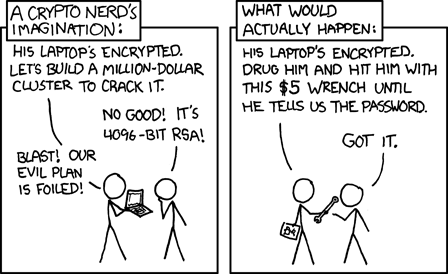 Unfortunately, so much of computer security is exactly this way. If the asset is of significant value, the bad guys won't fight fair (they'll fight bits with bats).
Friday, January 9, 2009
So you think you want a job in Computer Security
This is my blatant attempt to re-direct any aspiring, up-and-coming security professionals into another line of work, for the sake of their own physical and mental health.
...
So, you think you want a job in Computer Security, eh? Are you sure? Have you been properly informed what the work and conditions are really like? Do you have visions of Hollywood movies where Cheetos-eating one-handed-typists are madly furying away any would-be "hackers" and think you "want a job like that"? Or have you just heard about large salaries and want to make some extra do-re-mi for another coat of white paint on your picket fence? Or maybe still, you're one of those who think the "enlightened" few computer professionals rise above to the pinnacle of computer security research or applications, and you want a piece of that intellectual satisfaction?
Regardless of why you have been considering a job in computer security (or maybe you landed into one and you're wondering "How did I get here?" and "Now what?"), it is extremely likely you're missing a bit of a reality check you could have used prior to now. Now for a dose in reality ...
If you hope to change the world with your career, may I suggest a rewarding opportunity teaching high school math or science in a public school system? The pay is for shite, and there will be harder days than being a security professional, but your pupils will be grateful for your job well done later in life-- even if they don't manage to get around to tell you. Besides, everyone knows Americans spend what they make-- just learn to make ends meet on a teacher's salary.
...
[My general apologies for starting off 2009 with a lump that is hard to swallow.]
...
So, you think you want a job in Computer Security, eh? Are you sure? Have you been properly informed what the work and conditions are really like? Do you have visions of Hollywood movies where Cheetos-eating one-handed-typists are madly furying away any would-be "hackers" and think you "want a job like that"? Or have you just heard about large salaries and want to make some extra do-re-mi for another coat of white paint on your picket fence? Or maybe still, you're one of those who think the "enlightened" few computer professionals rise above to the pinnacle of computer security research or applications, and you want a piece of that intellectual satisfaction?
Regardless of why you have been considering a job in computer security (or maybe you landed into one and you're wondering "How did I get here?" and "Now what?"), it is extremely likely you're missing a bit of a reality check you could have used prior to now. Now for a dose in reality ...
- Perfect Security is not possible. It's not. It's depressing, I realize, but it's not. You may be surprised to find so many people working {Computer, Information, Network, System, Application, Software, Data, IT} {Security, Assurance, whatever} jobs who don't get that. I must admit that a former, more naiive version of myself once thought computer security was just getting some complicated recipe of hardware and software components just right. There's still a surprising number of "security professionals" out there who think that way. It's very depressing, but there's a very large "surface" to protect and it only takes a microscopic "chink" in your armor to lose everything. As a result, perfect security being not possible is the foundation to all other reasons why you should seriously re-consider your career aspirations.
- Most security work is really about making sure everyone else does their job "correctly". Correctness of systems is the real task at hand in a security job. Is it correct that a website of known sex offenders allows the general public to inject records of anyone they want labeled as such? Is it correct for a web server to execute arbitrary code if it is passed 1024 letter "A" characters? Is it correct that a user can click on a link and divulge intimate secrets to a total stranger because the page looks "normal" ? None of these are "correct" assuming even a smidge of common sense looking on afterwards. Yet they all have happened, and it was some security professional's job to deal with them. To put it simply, if everyone figured out how to design and implement systems "correctly" (assuming they know what is "correct" and what is "incorrect"), then security professionals would be out of a job, but thanks to #1 (perfect security is impossible), we're guaranteed to be picking up the poo poo flung by others from now until retirement, which means the following ...
- Security Response jobs suck. It may seem like CSI or something, but jobs that deal with responding to incidents suck. Except in high profile cases, computer forensics and true chain of custody techniques are not followed-- and if you want a computer forensics job, you'll probably have to work for a large government/public sector bureaucracy (and all the fun that goes with spending tax payers' dollars), which means you'll be primarily working on child pornography or drug trafficking cases and riding daily the fine line between public good and privacy infringements (warrantless wiretaps come to mind). My anecdotal observation is that very, very seldom do drug dealers and child porn traffickers actually employ decent computer security tactics; therefore, the job is lot less "CSI" and lot more mind-numbing "lather, rinse, repeat". From the words of someone I know who does this work: "I pretty much just push the big 'Go' button on EnCase [forensics software] and then show up at court explaining what it found." Not exactly the most intellectually stimulating work. The coolness factor wears off in the first 90 days, plus there's the joy of having convicted felons know who you are and that your work put them behind bars-- but not quite long enough, as they might still have a grudge against you when they get out. Even if you're lucky enough to not have a begrudging felon on your hands, there's the deep psychological torment that will slowly boil you alive if you are constantly exposed to the content of criminal minds. Your mileage may vary, but it probably won't be what you expect.
For those who hope to work responding to computer intrusions, you should realize that very few organizations can afford to keep people on staff who perform only computer intrusion investigations. Most orgs just want to know what it will take to get things back to normal, because to do a full root cause analysis on a computer system that generates revenue, well, that likely means the org will have to forego revenue, at least long enough to take a forensic snapshot of all of the data. Very rarely (mainly just high profile cases), will an org be able to afford that. So the competition is tough. Not to mention that in many publicly traded companies, there is indemnification from not knowing exactly how an intrusion occurred. And there's even more stigma if the details are made public. So there's just no incentive for them to really find out all of the details. The 20,000 foot view is good enough (e.g. "vulnerability in a web server").
And then there is an entirely different breed of "computer security professional": those who work on disaster recovery and business continuity planning and response. As you get engrossed in this sort of work, it tends to be less about "security" (critics: I realize "availability" is a tenet of the CIA Triad) and more about the daily employ of scare tactics to get organizations to fund remote data centers that are ready for the next apocalypse. The work is surprisingly more akin to "facilities" planning work: buildings, electric, plumbing. There is a "cyber" aspect to it, but it's mainly about funding the necessary equipment and then getting sysadmins to build it and test it out. That's project manager work; tedious, nanny-like, often political. It's not for people with short attention spans or high expectations. - Security Operations jobs suck more. Security Ops is at the bottom of the security professionals' totem pole. Most of these jobs are just sysadmins or network admins who have been promoted an extra notch, maybe because of that shiny new industry cert that some trade rag said was "hot" and would result in a 15% salary increase. But all of the usual sysadmin/network admin griefs apply here and then some. It's an operations job, so you inherit all of the problematic decisions that the project planning and implementation people lopped over the fence at you. Very rarely do Security Ops people in an org get to influence the architecture of future deployments. And besides lightweight tweaks like patches or an occasional config change, very rarely do Security Ops folks get to do much to systems "in production", especially for "legacy systems" (what part of "legacy" isn't a euphemism?). For the most part, it's sit back and watch to see if a security failure occurs. I use the word "failure" with specific intention, because Security Operations folks have to constantly keep delicate China plates spinning atop poles, because each plate represents a certain security failure. As it is with spinning plates, it's often about deciding which failure is more acceptable, not about preventing all failures (see #1, again).
In fact, there's an interesting twist: Security Ops managers or directors who experience a breach may find themselves losing their jobs on incompetence grounds. Going back to #1, this seems counter-intuitive. If we know perfect security is not possible, then we know security operations will experience a breach at some point (if we give them enough time). How, therefore, can you ever expect to be successful at a security operations job? When the shareholders want to know who was responsible for the unauthorized disclosure of thousands of company-crippling account records, the first person with the cross-hairs on their back is the person in charge of security operations. So, to survive at this game requires either company hopping before the inevitable breach occurs, OR, it requires politics (or black mail on somebody high up).
Outsourced security operations is just a variation of this. If the contract includes full accountability, it's one and the same as what is described above. If it's a "we monitor your systems that you are accountable for" scenario, then you as an individual security operations employee of the contract firm may not get fired, per se, but your company may lose the contract renewal, which means if you allow #1 (above) to be true too many times, then you might find yourself out of a job there, too.
The worst part about SecOps is that you'll either realize you've hit your Peter Principle with that job, in which case it's time to spend all of your free time on backyard barbecues and retirement planning (nothing necessarily wrong with that -- ignorance is bliss), OR, you'll want out immediately because everyone around you has hit their Peter Principle highest job and you want more. - Security Planning jobs are set up to fail. Think about it: perfect security is not possible. So, even the most cerebral of security planners is going to deliver a work product that has flaws and holes. If you can convince yourself that's not depressing and continue on, maybe you can also be lucky enough to get into an organization whose culture thinks it is acceptable for people to deliver faulty products to a Security Operations group (#4 above)-- and that it is entirely the Operations' people's faults when it capsizes. Not to worry, though, you probably won't work for an organization that can afford a true security response group (#3 above -- it's probably just the Security Operations' people who get to handle the full response process to break up their mundane day), so nobody may know it was your fault. Besides, if you're dealing with a bunch of vendors' COTS (Commercial Off The Shelf) wares, there's not a whole lot of control for you to have, which begs the question why your organization even has a position for you in the first place. They probably could have just paid some consultant for a couple weeks, rather than have you permanently on staff.
The other downsides are, of course, that you (like the Disaster Recovery & Business Continuity Planners) will also have to use scare tactics to implement draconian policies which probably won't actually amount to any real benefit, but some "power user" or Joe Software Developer will figure out he can circumvent them if he has two laptops and a flash drive (long personal anecdote story). If that doesn't work (or if you just want to cut to the chase), enter regulatory compliance into the equation: "Your project must do that stupid, expensive thing that results in no real added value because PCI says so!" It won't be a policy for something that 100% makes sense 100% of the time. Instead it will be something that makes life difficult for everyone (and everyone will love you for that), but is generally accepted by 3 out of 5 security professionals who also have no clue and are stuck in the dark ages (hence there are a lot self-perpetuating bad ideas out there, like firewalls and anti-virus). If you're an enlightened security strategist, you'll realize the futility of your job and want out, or you'll revert to also longing for weekend barbecues, vacations, and eventually retirement, all the while wondering if this is your Peter Principle job. - Security vendors have to sell out. They sell out because they thrive on the perpetuation of problems, selling subscription services to deal with them. Scare tactics are used so frequently the vendors are numb-- finding themselves unaware they're even using them. Not to mention, there are so many security vendors out there for startups and small boutiques alike that most security professionals on the potentially-receiving side of their goods and services haven't even heard of them. Or maybe they have? The names all sound so familiar, like: Securify, Securification, EnGuardiam, Bastillification ... they all seem to make sense if you're still in that state of mind after having woken up from an afternoon nap's dream, otherwise they reek of a society with too many marketing departments and far too many copyrighted words and phrases. If the company is any good, they'll eventually be swallowed up by one of the bigger fish, like Big Yellow (Symantec), Big Red (McAfee), Big Blue (IBM), or one of the other blander colors (HP, Microsoft, Google, etc.). Only a few stand strong as boutiques, and if they do, they almost certainly have a large bank or government contract as a customer.
Once you get a job at a security vendor, you'll probably be working as a developer who maintains a security product. And, as Gary McGraw has often pointed out, that's not about writing secure software, that's about writing security features into software. If you're not maintaining it, you'll be supporting it, which is the exact same as Security Operations (#4 above). You'll be the low level person who is stuck taking tickets, interpreting manuals (RTFM!), and talking to the Security Ops people at your customers' orgs. Fun times. Don't think for a second you'll go get a job at one of those big companies and fundamentally shake up their product lines and come out with cool new security-features-software that the Security Ops folks could really benefit from. These big companies get new ideas by buying the startups that create them; rarely does a lightbulb idea make its way into fruition. In fact, if you have such an epiphany and develop it as your brainchild into a security startup, rest assured that the bigger fish that swallows you up will succeed in turning your baby into yet-another-amalgamated product in their "enterprise suite" of products and services. It will lose its luster. They'll make the UI match the "portal" their customers already love to hate, but by then, you will have sold out and you can take your new nest egg with you into early retirement (weekend barbecues, here you come!).
If you're not one of those, then you will really be a sellout-- either a sales rep or a sales engineer. If you are somebody who like repeating what you say and do, this is the job for you, because you'll repeat the same lowly power point slide deck that marketing (you remember-- the people who came up with that killer company name!) for every customer-- that is, all of the customers that let you in past the cold call. If you're the sales rep, remember to drag along your sales engineer to get you out of a sticky situation where you promise some security perpetual motion where it's just not possible. And if you're the sales engineer, try to remember the security perpetual motion is just not possible. It'll be hard to tell the customer that, though, since it will say otherwise in the power point slide deck that marketing provided. It's be right there in big red letters: "Secure", "Unbreakable", "Keeps all hackers out", etc., etc., etc. - Pen Testers and Consultants have Commitment Issues. You can sell out, collect a paycheck, and position yourself in one of the jobs with the least amount of accountability and responsibility in the entire InfoSec space. The same is true for third party consultants, too. Any job where you are hired to come along and tell the hiring org where to put more bandaids falls into this category. Sure, there's a broad body of knowledge to comprehend ... but there are plenty of security vendors (see #6 above) who think they have a tool they can sell you so that you can point and click through your brief engagement with the hiring org, which begs the question: Why should they even hire you if an automated tool can give them their results? That's not true of all independent consultants and pen testers, though. Some of them do provide usefulness beyond that of a canned COTS tool. But they all suffer from the same problems as Security Planners (#5 above), only they probably had a prior job working directly for the org and saw how painful it was to stick around through the accountability phase after an incident. So now, they've learned their lesson: get in, get out, cash the check. They say: "Hey, it's a living." Are they the smartest security professionals around? Maybe. Do they have what it takes to do the other security jobs like Planning, Ops, and Incident Response? Maybe not.
- Exploit writers perpetuate the problem. All they do is sit on a chair all day in front of multiple computer screens (no doubt), and attempt to prove over and over again what academics have been saying since the 1970s. Yet there seems to be some economic sustainability, because otherwise the security vendors (#6 above) would have no way to sell you subscription services to access today's latest hack that a criminal otherwise might find on their own. But thanks to the vendor (and their handy, dandy exploit writer they have locked up somewhere with unlimited access to caffeine), we can all rest safely that the exploit code they just wrote won't be weaponized to prove #1 again (that happens all the time, actually), causing some poor Security Ops person (#4) to get sacked, while some Security Planner (#5) thinks "glad I'm on this side of the fence", and some Pen Tester (#7) thinks "I gotta download that into my pen testing tool for tomorrow's gig-- that way I know I'll find a hole and they'll hire me back next year".
- Security Educators either are paranoid or should be. If you're just contemplating a career in information or computer security for the first time, you probably aren't acquainted with any of the lovely people in this category, mainly because the good ones are expensive. Typically, it's only existing security professionals that get to experience security educators, because their employers realize that it's important to keep them up to date with information-- primarily thanks to exploit writers (#8) who keep the litany coming. The principles of security rarely change; only the scenery changes (and the exploit writers change scenery like the masters paint in oil).
Educators fall into one of two categories: 1) they suck because they've been out of the game for so long (if they were ever in it at all), or 2) they're spot on, but they don't want you to know what you're reading now because you may consider a career change and that's one less pupil, one less paycheck for them. If they're on top of their game, they're paranoid. They have trust issues with everything and everyone. They can't stay away from the topic, so they're very well-versed in what has happened as well as the current goings-on in the field of security, but they have worse commitment issues than Pen Testers and Consultants (#7). They have the ability to scare you, but not in the same way as the security vendors (#6) and security planners (#5); you'll be able to tell that they don't want anything in return-- it's almost a relief for them to share the information they know with someone. Sometimes a vendor sneaks in and pretends to be an educator. Beware of that; though the way to spot them is their horror stories will result in an emotion to buy a product or service. You won't come out having learned anything other than their products solve a niche need.
Becoming a security educator isn't an easy task; it typically means you were an educator of some other specialty domain and then learned how to teach security (which usually doesn't work as well as someone who has lived it), or you lived it yourself through one of the other job types and have educated yourself beyond the level of ordinary practitioners. If you're already in a security career and find yourself disheartened by the lacking options around you (because you've realized that it isn't the glamorous field you once thought), but find that you have an amazing affinity towards learning all that you can, this might be a saving grace that will prevent you from leaving everything you've learned behind and taking up a job as a dairy farmer (or some other similar job that will not require you to touch a computer). There's also the potential for life as an academic, where you caninfiltrateinspire open minds that have yet to be corrupted by corporate ways. - Security Media don't really exist. There are like 4 or 5 real "computer security reporters" in official media outlets. Anyone wanting to aspire to be them would have nearly as good of odds at becoming a professional athlete-- and that pays better. For all intents and purposes, they're either vanilla columnists whose writing glares that they don't understand the technical underpinnings of the subject of their writing, OR, they're paid bloggers.
- And Security Bloggers are the worst above all. (Present company included.) They know some or all of the above and chronicle it where they can, thinking that just collecting their thoughts in some digital pamphlet will change things. In order to be a security blogger of any real significance, you have to be known among the security community. For most, that means affiliation with a brand, product, or service. For a very elite few (the Schneiers out there), that means being one of the first to do so, calling everyone out for who they are, and taking as many opportunities to spout off in normal press/media as they'll allow (e.g. Schneier's a self-proclaimed "media slut"). For the rest of us, this may just be an attempt to alleviate the pressure of painful security information in our brains-- a pressure-release valve.
If you hope to change the world with your career, may I suggest a rewarding opportunity teaching high school math or science in a public school system? The pay is for shite, and there will be harder days than being a security professional, but your pupils will be grateful for your job well done later in life-- even if they don't manage to get around to tell you. Besides, everyone knows Americans spend what they make-- just learn to make ends meet on a teacher's salary.
...
[My general apologies for starting off 2009 with a lump that is hard to swallow.]
Tuesday, December 30, 2008
Forging RSA-MD5 SSL Certs
Wow. This is a big deal:
It is interesting to see a practical attack with MD5 collisions, though. Many people thought they weren't likely.
UPDATED: More info here, too.
The forged certificates will say they were issued by a CA called "Equifax Secure Global eBusiness", which is trusted by the major browsers. The forged certificates will be perfectly valid; but they will have been made by forgers, not by the Equifax CA.Browsers rarely get their list of approved CA certs modified throughout the course of their lives. Most people don't know how to change those, let alone why they should. In Firefox 3, the CA can be removed by going to Preferences > Advanced > Encryption > View Certificates > Authorities > Select the certificate and click delete. I assume the CA cert in question is the one with the following foot print, but cannot say for certain (since it has yet to be published):
To do this, the researchers exploited a cryptographic weakness in one of the digital signature methods, "MD5 with RSA", supported by the Equifax CA. The first step in this digital signature method is to compute the hash (strictly speaking, the cryptographic hash) of the certificate contents.
The hash is a short (128-bit) code that is supposed to be a kind of unique digest of the certificate contents. To be secure, the hash method has to have several properties, one of which is that it should be infeasible to find a collision, that is, to find two values A and B which have the same hash.
It was already known how to find collisions in MD5, but the researchers improved the existing collision-finding methods, so that they can now find two values R and F that have the same hash, where R is a "real" certificate that the CA will be willing to sign, and F is a forged certificate. This is deadly, because it means that a digital signature on R will also be a valid signature on F -- so the attacker can ask the CA to sign the real certificate R, then copy the resulting signature onto F -- putting a valid CA signature onto a certificate that the CA would never voluntarily sign.
8F:5D:77:06:27:C4:98:3C:5B:93:78:E7:D7:98:CCThe question is how to respond to this. There are many CAs that use RSA-MD5 instead of RSA-SHA1. Ripping them from the CA list is probably a good idea, even if it breaks a few web apps. If you are the admin of an e-commerce site using a cert issued by one of these RSA-MD5 CAs, you should probably: 1) Ask for your money back and switch to a different CA, 2) Ask for a new cert issued by an RSA-SHA1 CA, or 3) Forego the purchased certs in lieu of new RSA-SHA1 issued certs, probably in that order of effectiveness.
It is interesting to see a practical attack with MD5 collisions, though. Many people thought they weren't likely.
UPDATED: More info here, too.
Monday, December 8, 2008
The Stupidest PCI Requirement EVER!
The Payment Card Industry (PCI) regulatory compliance goals are good, but not perfect. Some individual requirements in the Data Security Standard (DSS) are flat out ridiculous. In particular, a couple regarding key management take the cake.
Consider an automated e-commerce system. The notion of automation means it works on its own, without human interaction. If that e-commerce system needs to process or store credit card numbers, it will need to encrypt and decrypt them as transactions happen. In order to do those cryptographic functions, the software must have access to the encryption key. It makes no sense for the software to only have part of the key or to rely on a pair of humans to provide it a copy of the key. That defeats the point of automation.
If the pieces of the key have to be put together for each transaction, then a human would have to be involved with each transaction-- definitely not worth the expense! Not to mention an exploit of a vulnerability in the software could result in malicious software keeping a copy of the full key once it's unlocked anyway (because it's the software that does the crypto functions, not 2 people doing crypto in their heads or on pen and paper!).
If a pair of humans are only involved with the initial unlocking of the key, then the software gets a full copy of the key anyway. Any exploit of a vulnerability in the software could potentially read the key, because the key is in its running memory. So, on the one hand, there is no requirement for humans to be involved with each interaction, thus the e-commerce system can operate more cheaply than, say, a phone-order system or a brick-and-mortar retailer. However, each restart of the application software requires a set of 2 humans to be involved with getting the system back and online. Imagine the ideal low-overhead e-commerce retailer planning vacation schedules for its minimal staff around this PCI requirement! PCI essentially dictates that more staff must be hired! Or, that support staff that otherwise would NOT have access to a portion of the key (because they take level 1 calls or work in a different group) now must be trusted with a portion of it. More hands involved means more opportunity for collusion, which increases the risk by increasing the likelihood of an incident, which is NOT what the PCI folks are trying to accomplish!
The difference between a cold war missile silo and an e-commerce software application is the number of "secure" transactions each must have. Missile silos do not launch missiles at the rate of several hundred to several thousand an hour, but good e-commerce applications can take that many credit cards. When there are few (albeit more important) transactions like entering launch codes, it makes sense to require the attention of a couple different people.
So splitting the key such that an e-commerce software application cannot have the full key is stupid.
But then there is the coup-de-grace in the "Testing Procedures" of 3.5.2:
In an e-commerce system, it's no different. All of the same pointlessness of splitting keys (as described above) still applies, but now there is an additional point of failure and complexity: the KEK. Encryption does add overhead to a software application's performance, though the trade-off is normally warranted. However, if at each transaction the software needs to use the KEK to unlock the DEK and then perform an encrypt or decrypt operation on a Credit Card number, the overhead is now double what it was previously. As such, most software applications that use KEKs don't do that. Instead, they just use the KEK to unlock the DEK and keep the DEK in memory throughout the duration of operation, until presumably the software or server need to be taken offline for reconfiguration of some kind. With an encryption key in memory, there's still the plausible risk that an exploit of a vulnerability in the software application could result in disclosure of the key or the records that are supposedly protected by it. Even if the key was once in memory, recent research reminds us that data remanence of RAM retains sensitive data like keys for longer than we might expect.
And if a software application is allowed to initiate and unlock its keys without a human (or pair of humans in the case of key splitting), such as the case when the e-commerce application calls for a distributed architecture of multiple application servers in a "farm", then there really is no point of having a second key. If the application can read the second key to unlock the first key, then so could an attacker that gets the same rights as the application. The software might as well just read in the first key in an unencrypted form, which would at least be a simpler design.
If the threat model is the server administrator stealing the keys, then what's the point? Administrators have FULL CONTROL. The administrator could just as easily steal the DEK and the KEK. And no, the answer is not encrypting the KEK with a KEKEK (Key-Encrypting-Key-Encrypting Key), nor with a KEKEKEK, etc., because no matter how many keys are involved (or how many safes with keys in them), the last one has to be in plaintext (readable) form! The answer is, make sure the Admins are trustworthy (which means do periodic background checks, psych evaluations if they are legal, pay them well and do your best to monitor their actions).
If the threat model is losing (or having stolen) a backup tape of a server's configuration and data, then, again, a KEK offers little help, since an attacker who has physical access to a storage device has FULL CONTROL and can read the KEK and then decrypt the DEK and the credit card records.
It is also commonly suggested by PCI assessors that KEKs be stored on different servers to deal with the threat of an administrator stealing the DEK. But that is really just the same as the problems above, just rehashed all over again.
If the application on Server A can automatically read in the KEK on Server B, then (again) a vulnerability in the application software could potentially allow malware to steal the KEK from Server B or cache a copy of it once in use. If the admin of Server A also has admin access to Server B, then it's the same problem there, too; the admin can steal the KEK from Server B and unlock the DEK on Server A. If the admin does NOT have access to the KEK, then it's the two-humans-required-for-support-scenarios all over again, like key splitting. If the KEK cannot be read by Server A when it is authorized to do so (such as the mechanism for reading the KEK from Server B is malfunctioning), then Server B's admin must be called (Murphy's Law indicates it will be off-hours, too) to figure out why it's not working. And in a small to medium sized e-commerce group, like in an ideal low-overhead operation, it will almost always be the same person or couple of people that have admin access to both. In the large scale, an admin of Server A and an admin of Server B can just choose to collude together and share the ill gains from the theft of the KEK, the DEK, and the encrypted credit card records.
What about a small e-commerce application, where the web, application, and database tiers are contained in one physical server for cost reasons? In that case, perhaps the "scope" of PCI compliance would have previously been a single server, but using a secondary server to house a single KEK now introduces that secondary server into the littany of other PCI requirements, which will likely erode the cost benefit of a single server to house all tiers of the application in the first place.
In the off-chance that a backup copy of Server A's configuration and data is lost or stolen, there will be a false sense of temporary hope if Sever B's backup is not also lost or stolen. However, collusion and/or social engineering of an admininstrator of Server B still applies. Also, this will allow an attacker time to reverse engineer the software that is now in the hands of the attacker. Is there a remote code execution bug in the software that could allow an attacker to leak either the full encryption key or individual credit card records? Is there a flaw in the way the crypto keys were generated or used that reduces the brute-force keyspace from the safety of its lofty 2^128 bit perch? Did the developers forget to turn off verbose logging after the support incident last weekend? Are there full transaction details in the clear in a log file? A better approach would be to just use some sort of full storage volume encryption INSTEAD of transaction encryption, such that none of those possibilities would occur. But in practice, that is rarely done to servers (and somehow not mandated by the PCI DSS).
So storing the KEK on multiple servers just introduces more support complexity than it reduces risk from data theft.
And if we now know that these requirements don't guarantee anything of substance that would pass Kerckhoff's Principle (i.e. security by obscurity does not make these key storage techniques more "secure"), then we can also say that having multiple keys, separate KEK storage, and key-splitting all violate 3.5.2 because the keys are not stored "securely in the fewest possible locations and forms".
...
To Recap: Splitting keys is not feasible in most cases; it negates the benefit from having less people involved with e-commerce. Encrypting keys with other keys is an attempt to implement computer security perpetual motion machines. If you really are paranoid, implement full volume encryption on your servers. If you're not, well, ditch the transaction crypto unless you just happen to have CPU cycles to spare. If you must be "PCI Compliant" (whatever that means outside of "not paying fines"), then implement your e-commerce app to have an "auditor mode" by default, where it requires two people to each type in part of a key for the application to initiate. Then let it have a normal "back door" mode where it just uses the regular key for everything. [Most PCI Assessors are not skilled or qualified enough to validate the difference by inspecting the software program's behavior. They really just want a screen shot to go into their pretty report. Of course, this requires a detailed understanding of the ethics involved, and your mileage may vary.]
And remember: "you're only paranoid if you're wrong."
...
UPDATED: It was pointed out that there is even one more crazy method that PCI Assessors think can turn this polished turd into alchemist's gold: "encode" the KEK into the software's binary. By "encode" they mean "compile", as in have a variable (probably a text string) that contains the value of the KEK. Rather than have the software read in that KEK value from a file, have it just apply the KEK from the static or constant variable in the decryption operation that unlocks the DEK. This is equally stupid as the above. If the point of having a KEK and a DEK is to prevent someone who has access to the file system from unlocking credit card records, then the PCI folks completely missed "intro to pen testing 101" which describes the ultra l33t h4x0r tool called "strings". Any text strings (ASCII, UNICODE, what have you) can be extracted by that ages-old command line utility. So, if the threat model is somebody who stole the contents of a server's disks-- they win. If the treat model is a server administrator-- they win. Not to mention, the common practices of software developers is to store source code in a repository, presumably a shared repository. Any static variable that is "encoded" into a binary will live in source code (unless, I guess, the developer is sadistic enough to fire up a hex editor and find/replace the ASCII values in the binary after it's compiled) and source code lives in repositories, which means even more opportunities for collusion. This type of crypto fairydust magic is pure fiction-- it just doesn't work like they think it does.
3.5.2 Store cryptographic keys securely in the fewest possible locations and forms.Hmm. Before we even get too far, there is a redundancy with 3.5.2 and 3.6.3. Why even have 3.5.2 if 3.6 covers the items in more detail? I digress ...
...
3.6 Fully document and implement all key-management processes and procedures for cryptographic keys used for encryption of cardholder data, including the following:
...
3.6.3 Secure cryptographic key storage.
3.6.6 Split knowledge and establishment of dual control of cryptographic keys.What the authors of the DSS were thinking was that PCI compliant merchants would implement cold war-esque missile silo techniques in which two military officers would each place a physical key into a control console and punch in their portion of the launch code sequence. This is technically possible to do with schemes like Adi Shamir's key splitting techniques. However, it rarely makes sense to do so.
Consider an automated e-commerce system. The notion of automation means it works on its own, without human interaction. If that e-commerce system needs to process or store credit card numbers, it will need to encrypt and decrypt them as transactions happen. In order to do those cryptographic functions, the software must have access to the encryption key. It makes no sense for the software to only have part of the key or to rely on a pair of humans to provide it a copy of the key. That defeats the point of automation.
If the pieces of the key have to be put together for each transaction, then a human would have to be involved with each transaction-- definitely not worth the expense! Not to mention an exploit of a vulnerability in the software could result in malicious software keeping a copy of the full key once it's unlocked anyway (because it's the software that does the crypto functions, not 2 people doing crypto in their heads or on pen and paper!).
If a pair of humans are only involved with the initial unlocking of the key, then the software gets a full copy of the key anyway. Any exploit of a vulnerability in the software could potentially read the key, because the key is in its running memory. So, on the one hand, there is no requirement for humans to be involved with each interaction, thus the e-commerce system can operate more cheaply than, say, a phone-order system or a brick-and-mortar retailer. However, each restart of the application software requires a set of 2 humans to be involved with getting the system back and online. Imagine the ideal low-overhead e-commerce retailer planning vacation schedules for its minimal staff around this PCI requirement! PCI essentially dictates that more staff must be hired! Or, that support staff that otherwise would NOT have access to a portion of the key (because they take level 1 calls or work in a different group) now must be trusted with a portion of it. More hands involved means more opportunity for collusion, which increases the risk by increasing the likelihood of an incident, which is NOT what the PCI folks are trying to accomplish!
The difference between a cold war missile silo and an e-commerce software application is the number of "secure" transactions each must have. Missile silos do not launch missiles at the rate of several hundred to several thousand an hour, but good e-commerce applications can take that many credit cards. When there are few (albeit more important) transactions like entering launch codes, it makes sense to require the attention of a couple different people.
So splitting the key such that an e-commerce software application cannot have the full key is stupid.
But then there is the coup-de-grace in the "Testing Procedures" of 3.5.2:
3.5.2 Examine system configuration files to verify that keys are stored in encrypted format and that key-encrypting keys are stored separately from data-encrypting keys.This is the ultimate in pointless PCI requirements. The real world analogue is taking valuables and stashing them in a safe that is unlocked with a key (the "data-encrypting key" or DEK in PCI parlance). Then, stash the key to the first safe into a second safe also unlocked by a key (the "key-encrypting key" or KEK in PCI parlance). Presumably, at this point, this second key will be like something out of a James Bond film where the key is actually in two parts, each possessed by one of two coordinating parties who reside in two geographically distinct locations. In practice, however, the second key is typically just slipped under the floor mat and the two safes are sitting right next to one another. It takes a little longer to get the valuables out of the safe, but does little to actually prevent a thief from doing so.
In an e-commerce system, it's no different. All of the same pointlessness of splitting keys (as described above) still applies, but now there is an additional point of failure and complexity: the KEK. Encryption does add overhead to a software application's performance, though the trade-off is normally warranted. However, if at each transaction the software needs to use the KEK to unlock the DEK and then perform an encrypt or decrypt operation on a Credit Card number, the overhead is now double what it was previously. As such, most software applications that use KEKs don't do that. Instead, they just use the KEK to unlock the DEK and keep the DEK in memory throughout the duration of operation, until presumably the software or server need to be taken offline for reconfiguration of some kind. With an encryption key in memory, there's still the plausible risk that an exploit of a vulnerability in the software application could result in disclosure of the key or the records that are supposedly protected by it. Even if the key was once in memory, recent research reminds us that data remanence of RAM retains sensitive data like keys for longer than we might expect.
And if a software application is allowed to initiate and unlock its keys without a human (or pair of humans in the case of key splitting), such as the case when the e-commerce application calls for a distributed architecture of multiple application servers in a "farm", then there really is no point of having a second key. If the application can read the second key to unlock the first key, then so could an attacker that gets the same rights as the application. The software might as well just read in the first key in an unencrypted form, which would at least be a simpler design.
If the threat model is the server administrator stealing the keys, then what's the point? Administrators have FULL CONTROL. The administrator could just as easily steal the DEK and the KEK. And no, the answer is not encrypting the KEK with a KEKEK (Key-Encrypting-Key-Encrypting Key), nor with a KEKEKEK, etc., because no matter how many keys are involved (or how many safes with keys in them), the last one has to be in plaintext (readable) form! The answer is, make sure the Admins are trustworthy (which means do periodic background checks, psych evaluations if they are legal, pay them well and do your best to monitor their actions).
If the threat model is losing (or having stolen) a backup tape of a server's configuration and data, then, again, a KEK offers little help, since an attacker who has physical access to a storage device has FULL CONTROL and can read the KEK and then decrypt the DEK and the credit card records.
It is also commonly suggested by PCI assessors that KEKs be stored on different servers to deal with the threat of an administrator stealing the DEK. But that is really just the same as the problems above, just rehashed all over again.
If the application on Server A can automatically read in the KEK on Server B, then (again) a vulnerability in the application software could potentially allow malware to steal the KEK from Server B or cache a copy of it once in use. If the admin of Server A also has admin access to Server B, then it's the same problem there, too; the admin can steal the KEK from Server B and unlock the DEK on Server A. If the admin does NOT have access to the KEK, then it's the two-humans-required-for-support-scenarios all over again, like key splitting. If the KEK cannot be read by Server A when it is authorized to do so (such as the mechanism for reading the KEK from Server B is malfunctioning), then Server B's admin must be called (Murphy's Law indicates it will be off-hours, too) to figure out why it's not working. And in a small to medium sized e-commerce group, like in an ideal low-overhead operation, it will almost always be the same person or couple of people that have admin access to both. In the large scale, an admin of Server A and an admin of Server B can just choose to collude together and share the ill gains from the theft of the KEK, the DEK, and the encrypted credit card records.
What about a small e-commerce application, where the web, application, and database tiers are contained in one physical server for cost reasons? In that case, perhaps the "scope" of PCI compliance would have previously been a single server, but using a secondary server to house a single KEK now introduces that secondary server into the littany of other PCI requirements, which will likely erode the cost benefit of a single server to house all tiers of the application in the first place.
In the off-chance that a backup copy of Server A's configuration and data is lost or stolen, there will be a false sense of temporary hope if Sever B's backup is not also lost or stolen. However, collusion and/or social engineering of an admininstrator of Server B still applies. Also, this will allow an attacker time to reverse engineer the software that is now in the hands of the attacker. Is there a remote code execution bug in the software that could allow an attacker to leak either the full encryption key or individual credit card records? Is there a flaw in the way the crypto keys were generated or used that reduces the brute-force keyspace from the safety of its lofty 2^128 bit perch? Did the developers forget to turn off verbose logging after the support incident last weekend? Are there full transaction details in the clear in a log file? A better approach would be to just use some sort of full storage volume encryption INSTEAD of transaction encryption, such that none of those possibilities would occur. But in practice, that is rarely done to servers (and somehow not mandated by the PCI DSS).
So storing the KEK on multiple servers just introduces more support complexity than it reduces risk from data theft.
And if we now know that these requirements don't guarantee anything of substance that would pass Kerckhoff's Principle (i.e. security by obscurity does not make these key storage techniques more "secure"), then we can also say that having multiple keys, separate KEK storage, and key-splitting all violate 3.5.2 because the keys are not stored "securely in the fewest possible locations and forms".
...
To Recap: Splitting keys is not feasible in most cases; it negates the benefit from having less people involved with e-commerce. Encrypting keys with other keys is an attempt to implement computer security perpetual motion machines. If you really are paranoid, implement full volume encryption on your servers. If you're not, well, ditch the transaction crypto unless you just happen to have CPU cycles to spare. If you must be "PCI Compliant" (whatever that means outside of "not paying fines"), then implement your e-commerce app to have an "auditor mode" by default, where it requires two people to each type in part of a key for the application to initiate. Then let it have a normal "back door" mode where it just uses the regular key for everything. [Most PCI Assessors are not skilled or qualified enough to validate the difference by inspecting the software program's behavior. They really just want a screen shot to go into their pretty report. Of course, this requires a detailed understanding of the ethics involved, and your mileage may vary.]
And remember: "you're only paranoid if you're wrong."
...
UPDATED: It was pointed out that there is even one more crazy method that PCI Assessors think can turn this polished turd into alchemist's gold: "encode" the KEK into the software's binary. By "encode" they mean "compile", as in have a variable (probably a text string) that contains the value of the KEK. Rather than have the software read in that KEK value from a file, have it just apply the KEK from the static or constant variable in the decryption operation that unlocks the DEK. This is equally stupid as the above. If the point of having a KEK and a DEK is to prevent someone who has access to the file system from unlocking credit card records, then the PCI folks completely missed "intro to pen testing 101" which describes the ultra l33t h4x0r tool called "strings". Any text strings (ASCII, UNICODE, what have you) can be extracted by that ages-old command line utility. So, if the threat model is somebody who stole the contents of a server's disks-- they win. If the treat model is a server administrator-- they win. Not to mention, the common practices of software developers is to store source code in a repository, presumably a shared repository. Any static variable that is "encoded" into a binary will live in source code (unless, I guess, the developer is sadistic enough to fire up a hex editor and find/replace the ASCII values in the binary after it's compiled) and source code lives in repositories, which means even more opportunities for collusion. This type of crypto fairydust magic is pure fiction-- it just doesn't work like they think it does.
Monday, October 27, 2008
Banks, Malware, and More Failing Tokens
The Kaspersky folks have an interesting report on malware that targets the banking and financial markets that supports and echoes many of the things posted here over the last several months. For one, the banking industry is receiving targeted malware, which makes it more difficult for "signature" based anti-malware solutions to find the malware. For two, issues with second-factor authentication tokens don't solve the malware-in-the-browser problem.
"In order for a cyber criminal to be able to perform transactions when dynamic passwords are in place using phishing, s/he has to use a Man-in-the-Middle attack.... Setting up a MitM attack is inherently more difficult than setting up a standard phishing site; however, there are now MitM kits available, so cyber criminals can create attacks on popular banks with a minimum of effort."
Tuesday, September 23, 2008
Venema on Spam
I'm grateful for physicist Wietse Venema's contributions (satan, the coroner's toolkit, TCP Wrappers, and Postfix) to the computer security world, but I certainly Venema's anti-spam solution never gets implemented:
I'm all in favor of changing economics of the situation. I just don't think this has it.
Except that his proposed "pull" model would change the incentives in such a way that email uers' would not opt-in. Blackberries and the like use a "push" model today so that busy execs (or wannabe middle managers) can read email while in the tube trains without connectivity. Gmail wants to have that message pulled down and indexed, ready for searching (a different set of security issues). Not to mention that the users will now have to make decisions about whether or not to "pull" email based on just the meta information, not full content inspection (e.g. sender's address and subject line). What happens when my friend is hijacked and has his outgoing mailbox full of spam or viruses destined for me? I would have to tell without the details. Often, I cannot tell whether something is worth reading without skimming the body of the message. It could be my bank telling me my statement is available or that they want to offer me yet another home equity loan (the former is interesting; the latter is junk). It's just not going to work.The best theoretic solution is to change the email distribution model, but this may never happen. Right now, email is a "push" technology where the sender has most of the control, and where the receiver bears most of the cost.
The alternative is to use a "pull" model, where the sender keeps the email message on their own server until the receiver downloads it. For example, when my bank wants to send me email, they would send a short message with an URL to view their mail, and my email software would download the message for me. This assumes of course that my email software recognizes my bank's email digital signature and their Web site's SSL certificate, otherwise we would have a phishing problem. Legacy mail software would tell the user that they have email at their bank, and leave it up to the user to download their email.
The "pull" model would change the economics of email. It would move the bulk of the cost from the receivers where it is now, to the senders where it belongs. No-one would read email if its sender doesn't provide a service where recipients can download it from.
I'm all in favor of changing economics of the situation. I just don't think this has it.
Saturday, September 13, 2008
Computer Security is Harder than Nuclear Physics
It's official. We now have conclusive evidence. Computer Security is, in fact, more difficult than nuclear physics. I submit to you, exhibit A:
In all seriousness, computer security is a difficult problem. Very difficult. So difficult, that it is usually not even properly defined. In this HUGE scientific experiment, with $Billions spent to achieve success to the point where they currently are, not to mention the world's brightest scientists (and no doubt a tip-top IT staff to support them) there still was at least one vulnerability that threatened total loss of control of all of their IT systems (including the ones controlling the new controversial device).As the first particles were circulating in the machine near Geneva where the world wide web was born, a Greek group hacked into the facility, posting a warning about weaknesses in its infrastructure.Calling themselves the Greek Security Team, the interlopers mocked the IT used on the project, describing the technicians responsible for security as "a bunch of schoolkids."
However, despite an ominous warning "don't mess with us," the hackers said they had no intention of disrupting the work of the atom smasher."We're pulling your pants down because we don't want to see you running around naked looking to hide yourselves when the panic comes," they wrote in Greek in a rambling note posted on the LHC's network.The scientists behind the £4.4 billion "Big Bang" machine had already received threatening emails and been besieged by telephone calls from worried members of the public concerned by speculation that the machine could trigger a black hole to swallow the earth, or earthquakes and tsunamis, despite endless reassurances to the contrary from the likes of Prof Stephen Hawking.The website - www.cmsmon.cern.ch - can no longer be accessed by the public as a result of the attack.Scientists working at Cern, the organisation that runs the vast smasher, were worried about what the hackers could do because they were "one step away" from the computer control system of one of the huge detectors of the machine, a vast magnet that weighs 12500 tons, measuring around 21 metres in length and 15 metres wide/high.If they had hacked into a second computer network, they could have turned off parts of the vast detector and, said the insider, "it is hard enough to make these things work if no one is messing with it."Fortunately, only one file was damaged but one of the scientists firing off emails as the CMS team fought off the hackers said it was a "scary experience".The hackers targeted the Compact Muon Solenoid Experiment, or CMS, one of the four "eyes" of the facility that will be analysing the fallout of the Big Bang.The CMS team of around 2000 scientists is racing with another team that runs the Atlas detector, also at Cern, to find the Higgs particle, one that is responsible for mass."There seems to be no harm done. From what they can tell, it was someone making the point that CMS was hackable," said James Gillies, spokesman for Cern. "It was quickly detected."
Saturday, August 23, 2008
Gmail Mobile Insecurity
Google just released a new set of security features for Gmail. However, you cannot turn on the "always use HTTPS" option if you are also using the older java based Gmail Mobile client for smart phones, like the Blackberry. They have written that app to always fetch new mail and post actions like delete and archive over HTTP instead of HTTPS. With Gmail's new require-HTTPS feature enabled, the mobile client will error out that it cannot fetch mail. The new version (2.0.5 as of right now), is a little quirky with this setting, but it will work with require-HTTPS enabled.
Without the new version, smart phones which can fetch content over local WiFi have a ready made attack vector. Blackberries, which route all traffic through an encrypted tunnel back to the company's BES (Blackberry Enterprise Server), would find themselves vulnerable to eavesdropping and MITM closer to the BES (i.e. the corporate LAN), or, of course, at any hop along the way from the corporate LAN through the ISPs (but ISPs would never snoop on your email ;).
With these embedded devices, how many people stop to think about which protocols these apps use under the hood? It's not like on a traditional browser, where the user can at least monitor link destinations via a status bar. I would also venture to say that not too many people worry about keeping app versions up to date-- there haven't been too many nagging update applications for the majority of smart phones, yet. Google's Mobile Updater requires the user to go in and manually check for new versions. So, it's even more imperative for these app developers to get it right the first time.
Gmail Notifier is also experiencing similar issues.
Without the new version, smart phones which can fetch content over local WiFi have a ready made attack vector. Blackberries, which route all traffic through an encrypted tunnel back to the company's BES (Blackberry Enterprise Server), would find themselves vulnerable to eavesdropping and MITM closer to the BES (i.e. the corporate LAN), or, of course, at any hop along the way from the corporate LAN through the ISPs (but ISPs would never snoop on your email ;).
With these embedded devices, how many people stop to think about which protocols these apps use under the hood? It's not like on a traditional browser, where the user can at least monitor link destinations via a status bar. I would also venture to say that not too many people worry about keeping app versions up to date-- there haven't been too many nagging update applications for the majority of smart phones, yet. Google's Mobile Updater requires the user to go in and manually check for new versions. So, it's even more imperative for these app developers to get it right the first time.
Gmail Notifier is also experiencing similar issues.
Saturday, August 16, 2008
The Case of MIT Subway Hackers
By now, you may have read about a group of MIT Students who were set to present some insecurity details of the "CharlieCard" subway system used in Boston and elsewhere. [I myself had wondered just exactly what data resides on the magnetic stripes of a similar transit card from the Washington DC subway system, just this summer. It doesn't take much hard thinking to realize that a requirement for these machines is that they have to work regardless of whether there is connectivity back to the central office to validate a transit card; ergo, there must be monetary values stored on the card.] The transit authority didn't like it and got a federal judge to issue a gag order. A lot of good that did, because MIT still has the presentation (and other items) posted here. And now the Electronic Frontier Foundation is fighting the legal battle for the students. But the real question here (which stirs the disclosure debate once again) is: Who is at fault here?
Short version: everybody is at fault.
Long version ...
On the one hand, this group of students, led by world renown Ron Rivest (that's right, the "R" in the "RSA" encryption alogorithm), only informed the transit authority a week before the presentation that they were going to give the talk at DEFCON. That's right, just 1 week. And their advisor, Ron Rivest, was out of town for at least part of that time. The CFP (Call For Papers) closed on May 15. DEFCON's policy is to notify submissions of acceptance within two business days. So the MIT undergrads should have known no later than Monday, May 19, that they were going to be giving the talk. This wasn't impromptu. In order to get accepted, they would have had to bring the goods. So, they clearly knew enough to start the communication process with the Transit Authority. Giving the MBTA less than a week to respond (this is the bureaucratic US government we're talking about-- nothing gets done in one week) certainly put them on the defensive. That was a stupid mistake by the MIT crew.
On the other hand, fueled by a stick-your-head-in-the-sand and an I-hate-academic-research pair of attitudes, the Transit Authority's gag order really sets a dangerous precedent. Two Ivy League Computer Science Professors with quite the reputation when it comes to security, Matt Blaze at U Penn and Columbia University's Steve Bellovin, have spoken out against this bad precedent, arguing that it stifles needed future research. They also signed a letter from the EFF in an attempt to overturn the ruling (PDF). Here is the list of Professors and Researchers who signed the letter:
Another fault is that both the Federal courts and the MBTA thought they could control the dissemination of the information solely with a gag order. Have they any clue exactly what sort of people attend Blackhat and DEFCON every August in Las Vegas? The injunction was late; the CDs with presentation materials were already printed and distributed to paying attendees. Good luck getting that content back (even if MIT wasn't bold enough to keep it posted). And there's another HUGE side-effect by gagging presenters at DEFCON: it spurs interest in the roughly 6 or 7 thousand attendees (and all of the others around the world who didn't attend for one reason or another) to take what little knowledge is known (i.e. subway payment system cards can be hacked to get free rides) and make an all-out war against the people trying to withold the information (the MBTA). Even if the talk wasn't one of the best this year, it now holds an elusive status, which is more than enough justification for a bunch of people (who are paid to understand how systems break) to spend extra time figuring out the forboden details. That was plain stupid on the MBTA's part. Even if they thought the students were criminal or inciting criminal fraud, they should have taken another approach (e.g. finding a way to make them financially liable for lost revenue due to fraud committed by these techniques-- not that I condone that action, it just would have been more effective).
How could this have gone better?
Well, Ron Rivest, on behalf of his students, could have contacted the MBTA months in advance. They could have scheduled full briefs with the appropriate audiences without the pressure to immediately act (which is what resulted in the MBTA calling the FBI and pursuing a fraud investigation against the students).
Short version: everybody is at fault.
Long version ...
On the one hand, this group of students, led by world renown Ron Rivest (that's right, the "R" in the "RSA" encryption alogorithm), only informed the transit authority a week before the presentation that they were going to give the talk at DEFCON. That's right, just 1 week. And their advisor, Ron Rivest, was out of town for at least part of that time. The CFP (Call For Papers) closed on May 15. DEFCON's policy is to notify submissions of acceptance within two business days. So the MIT undergrads should have known no later than Monday, May 19, that they were going to be giving the talk. This wasn't impromptu. In order to get accepted, they would have had to bring the goods. So, they clearly knew enough to start the communication process with the Transit Authority. Giving the MBTA less than a week to respond (this is the bureaucratic US government we're talking about-- nothing gets done in one week) certainly put them on the defensive. That was a stupid mistake by the MIT crew.
On the other hand, fueled by a stick-your-head-in-the-sand and an I-hate-academic-research pair of attitudes, the Transit Authority's gag order really sets a dangerous precedent. Two Ivy League Computer Science Professors with quite the reputation when it comes to security, Matt Blaze at U Penn and Columbia University's Steve Bellovin, have spoken out against this bad precedent, arguing that it stifles needed future research. They also signed a letter from the EFF in an attempt to overturn the ruling (PDF). Here is the list of Professors and Researchers who signed the letter:
- Prof David Farber, Carnegie Mellon
- Prof Steven M Bellovin, Columbia University
- Prof David Wagner, UC Berkeley
- Prof Dan Wallach, Rice University
- Prof Tadayoshi Kohno, U Washington
- Prof David Touretzky, Carnegie Mellon
- Prof Patrick McDaniel, Penn State University
- Prof Lorrie Faith Cranor, Carnegie Mellon
- Prof Matt Blaze, U Penn
- Prof Stefan Savage, UC San Diego
- Bruce Schneier
Another fault is that both the Federal courts and the MBTA thought they could control the dissemination of the information solely with a gag order. Have they any clue exactly what sort of people attend Blackhat and DEFCON every August in Las Vegas? The injunction was late; the CDs with presentation materials were already printed and distributed to paying attendees. Good luck getting that content back (even if MIT wasn't bold enough to keep it posted). And there's another HUGE side-effect by gagging presenters at DEFCON: it spurs interest in the roughly 6 or 7 thousand attendees (and all of the others around the world who didn't attend for one reason or another) to take what little knowledge is known (i.e. subway payment system cards can be hacked to get free rides) and make an all-out war against the people trying to withold the information (the MBTA). Even if the talk wasn't one of the best this year, it now holds an elusive status, which is more than enough justification for a bunch of people (who are paid to understand how systems break) to spend extra time figuring out the forboden details. That was plain stupid on the MBTA's part. Even if they thought the students were criminal or inciting criminal fraud, they should have taken another approach (e.g. finding a way to make them financially liable for lost revenue due to fraud committed by these techniques-- not that I condone that action, it just would have been more effective).
How could this have gone better?
Well, Ron Rivest, on behalf of his students, could have contacted the MBTA months in advance. They could have scheduled full briefs with the appropriate audiences without the pressure to immediately act (which is what resulted in the MBTA calling the FBI and pursuing a fraud investigation against the students).
Wednesday, August 13, 2008
Linux SSO to AD
This is a break from the traditional types of posts. It's more of an instructional howto, but I hope that it is valuable nonetheless.
...
Ah, the holy grail of Identity Management: Single Sign On. And in today's enterprise, that likely means Microsoft's Active Directory at the back end. While directions for bringing unix/linux boxes into the AD forest have been out there, they have been sticky at least, requiring random config changes to PAM, Kerberos, Samba, LDAP(S), etc.
Enter likewise-open, which is a great way to package all those up. It's a free software package that also comes with optional enterprise support, which anti-free-and-open-source companies tend to like.
Sure, there are tons of great examples out there that will tell you how to get likewise-open installed (which is a dream compared to the old days of manually configuring Kerberos, PAM, etc.). BUT, they leave you high and dry with any user in the whole domain (possibly the forest) being able to log into the computer, since they focus on "authentication" and not "authorization". Since when is that better than less passwords? They also don't properly show how to manage privileged access once logged in. So the following are some subtle configuration details and nuggets for which I have had to comb the web and anyone who really does enterprise SSO will appreciate.
This will assume you have likewise-open installed, which if you don't, on Ubuntu it's as simple as: sudo apt-get install likewise-open.
For that matter, this entire thing assumes Ubuntu, but would work elsewhere (paths may vary).
Joining to the domain is very easy, too: sudo domainjoin-cli join fully.qualified.domain.name UserID
Now, you probably want to limit who can log on to the shell to just admins. After all, it's Unix; it's not a toy. Use your favorite text editor (as root or sudo) and edit /etc/security/pam_lwidentity.conf. Uncomment this line require_membership_of and add an AD group containing those admins in the Domain\Group format.
Next you'll want to make sure those admins can use sudo otherwise you'll have a root password management problem (the whole point of SSO is to reduce the number of passwords to manage, right?). Edit the /etc/sudoers file by typing sudo visudo and add a line in this format: %DOMAIN\\Group ALL=(ALL) ALL (if you want to allow everything-- follow normal sudo permissions rules to restrict further).
Last, but not least, you'll probably want to get a psychological acceptance from administrators as a security design principle, right? In order to do that, let's get rid of that pesky Domain\UserID format and just use the UserID format. After all, who wants to type in ssh 'domain\userid'@computername when they can just type in ssh computername? This is the coup de grâce in favor of less passwords. Again, as root or sudo, edit /etc/samba/lwiauthd.conf and add winbind use default domain = yes to the end of the file. If you're in a multi-domain forest, you're up a creek (not to mention you probably have a less than simple environment anyway), and at a minimum your users in other domains will have to specify the domain\userid format. But users in the same domain can log in without the domain\ prefix.
One recipe for quick SSO to AD on Unix/Linux in a mere few minutes. Enjoy.
...
Ah, the holy grail of Identity Management: Single Sign On. And in today's enterprise, that likely means Microsoft's Active Directory at the back end. While directions for bringing unix/linux boxes into the AD forest have been out there, they have been sticky at least, requiring random config changes to PAM, Kerberos, Samba, LDAP(S), etc.
Enter likewise-open, which is a great way to package all those up. It's a free software package that also comes with optional enterprise support, which anti-free-and-open-source companies tend to like.
Sure, there are tons of great examples out there that will tell you how to get likewise-open installed (which is a dream compared to the old days of manually configuring Kerberos, PAM, etc.). BUT, they leave you high and dry with any user in the whole domain (possibly the forest) being able to log into the computer, since they focus on "authentication" and not "authorization". Since when is that better than less passwords? They also don't properly show how to manage privileged access once logged in. So the following are some subtle configuration details and nuggets for which I have had to comb the web and anyone who really does enterprise SSO will appreciate.
This will assume you have likewise-open installed, which if you don't, on Ubuntu it's as simple as: sudo apt-get install likewise-open.
For that matter, this entire thing assumes Ubuntu, but would work elsewhere (paths may vary).
Joining to the domain is very easy, too: sudo domainjoin-cli join fully.qualified.domain.name UserID
Now, you probably want to limit who can log on to the shell to just admins. After all, it's Unix; it's not a toy. Use your favorite text editor (as root or sudo) and edit /etc/security/pam_lwidentity.conf. Uncomment this line require_membership_of and add an AD group containing those admins in the Domain\Group format.
Next you'll want to make sure those admins can use sudo otherwise you'll have a root password management problem (the whole point of SSO is to reduce the number of passwords to manage, right?). Edit the /etc/sudoers file by typing sudo visudo and add a line in this format: %DOMAIN\\Group ALL=(ALL) ALL (if you want to allow everything-- follow normal sudo permissions rules to restrict further).
Last, but not least, you'll probably want to get a psychological acceptance from administrators as a security design principle, right? In order to do that, let's get rid of that pesky Domain\UserID format and just use the UserID format. After all, who wants to type in ssh 'domain\userid'@computername when they can just type in ssh computername? This is the coup de grâce in favor of less passwords. Again, as root or sudo, edit /etc/samba/lwiauthd.conf and add winbind use default domain = yes to the end of the file. If you're in a multi-domain forest, you're up a creek (not to mention you probably have a less than simple environment anyway), and at a minimum your users in other domains will have to specify the domain\userid format. But users in the same domain can log in without the domain\ prefix.
One recipe for quick SSO to AD on Unix/Linux in a mere few minutes. Enjoy.
Thursday, June 26, 2008
Breaking Cisco VPN Policy
I am surprised how often I hear an organization operate under the belief that they can really, truly can control what a remote client does under any situation. Here is today's lesson on how you can never know what computer is on the other end of the Cisco VPN tunnel or how it is behaving, thanks to more "opt-in security".
Step 1: Break the misconception that Cisco VPN concentrators authenticate which computer is on the other end of the tunnel.
Cisco VPNs authenticate people, not computers. When the connection is initiated from a client, sure the client passes a "group password" before the user specifies her credentials, but there's nothing that really restricts that group password to your organization's computers.
Consider this: any user who runs the Cisco VPN Client has to have at least read access to the VPN profile (the .pcf files stored in the Program Files --> Cisco Systems --> VPN --> Profiles folders on Windows systems). If the user has READ access, any malware unintentionally launched as that user could easily steal the contents of the file ... and the "encrypted" copy of the group password stored within it. Or, a Cisco VPN client can be downloaded from the web and the .pcf VPN profile can be imported into it. At that point, it's no longer certain that the connection is coming from one of your computers.
Step 2: Break the misconception that the client is even running the platform you expect.
So since any user has READ access to the .pcf VPN profiles, they can open up the text config file in a text editor like notepad, peruse the name-value pairs for the "enc_GroupPwd" value, copy everything after the equal sign ("="), and paste it into a Cisco VPN client password decoder script like this one. A novice, in less than a minute, can have everything she needs to not only make VPN connections from an unexpected device, but also from an unexpected platform. Not to mention the group password is not really all that secret.
Cisco VPN encrypted group passwords, like any encrypted data that an automated system (i.e. software) needs to unlock without interrogating user for a key value that only a human knows, must be stored in such a way that is readable for the software. Even though the name/value pair for group passwords in Cisco profiles is labeled as "encrypted" group password, the software needs to be able to decrypt it to use it when establishing VPN tunnels, which means the group password is also read-accessible for any reverse engineer (hence this source code in C). So it is now trivial to decode a Cisco group password. This is not an attack on crypto, this is an attack on key management coupled with a misunderstanding on how compiled programs work.
Now that a "decrypted" copy of the group password is known, the open source "vpnc" package can pretend to be the same as the commercial Cisco version. Here's how simple Ubuntu makes configuring vpnc to emulate a Cisco client:

A Cisco VPN concentrator (or any other server in a client-server relationship) cannot know for sure what the remote client's platform really is. Any changes Cisco makes to its client to differentiate a "Cisco" client by behavior from, say, a "vpnc" client, can be circumvented by doing a little reverse engineering and coding the emulation of the new behavior into the "vpnc" package. An important thing to keep present in one's mind is that compiled applications, although obscure, are not completely obfuscated beyond recognition. A binary of a program is not like a "ciphertext" in the crypto world. It has to be "plaintext" to the OS & CPU that execute it. If it was not readable, then the instructions could not be read and loaded into the CPU for execution. So, any controls based on compiled code are fruitless. Sure, there will be a window of time from when the changes are deployed in the official client to when they are emulated by a hacked client, but reverse engineering and debugging tools (such as bindiff and OllyDbg) are getting more and more sophisticated, reducing the time barrier.
Step 3: Break the misconception that you can remotely control a client's behavior.
A "client" is just that ... it's a "client". It's remote. You cannot physically touch it. Any commands you send to it have to be accepted by it before they are executed. Case in point with the Cisco VPN client is the notion that "network security" people try to perpetuate: "split-tunneling is bad, so let's disable it." Network security people don't like split tunnels or split routes because they view it as a way of bridging a remote client's local network and the organization's internal network. However, it's futile to get all worked up about it. If you trust clients to remote in, then you cannot control how they choose to route packets (though you can pretend that what I show below doesn't really exist, I guess.)


In the same Ubuntu screen shot above, there's a quick and easy way to implement split-tunnels. It's the "Only use VPN connection for these addresses" check box. Check the box and specify the IP ranges. Voila! You've got a split tunnel. Don't want to route the Internet through your company's slow network or cumbersome filters? Check the box. Want to access a local file share while connected to an app your organization refuses to web-enable? Check the box. You get the idea. This is an excellent example of how many "network security" people believe they can control a remote client, yet as you can see, the only way to continue the misconception is to ignore distributed computing principles.
Doing what I described above is certainly not "new" information-- clearly because there are now GUIs to do it (so it's obviously very mature). However, the principles are still not well known and we have vendors like Cisco continuing the notion that you can remotely control a client by upping the ante. Many organizations' network security people are considering the deployment of NAC ("network access control") with VPN. Microsoft has had an implementation of it (they call it NAP for "network access protection") for years. The problem is, it's based on this false sense of "opt-in security" just like split tunnels. Let's look at an analogy ...
So, to refute implementation specific objections, there are two key ways for a project, such as the vpnc project, to choose to not "opt-in" if so desired. They both involve lying to the server (VPN concentrator):
...
So to recap: you cannot control a client or truly know anything about it. It's just not possible, so security practitioners should look to setting policies that include the fact that you cannot control a remote client. For a great in-depth review of all of these principles (with tons more examples), I suggest picking up a copy of Gary McGraw's and Greg Hoglund's "Exploiting Software: How to break code" book.
Step 1: Break the misconception that Cisco VPN concentrators authenticate which computer is on the other end of the tunnel.
Cisco VPNs authenticate people, not computers. When the connection is initiated from a client, sure the client passes a "group password" before the user specifies her credentials, but there's nothing that really restricts that group password to your organization's computers.
Consider this: any user who runs the Cisco VPN Client has to have at least read access to the VPN profile (the .pcf files stored in the Program Files --> Cisco Systems --> VPN --> Profiles folders on Windows systems). If the user has READ access, any malware unintentionally launched as that user could easily steal the contents of the file ... and the "encrypted" copy of the group password stored within it. Or, a Cisco VPN client can be downloaded from the web and the .pcf VPN profile can be imported into it. At that point, it's no longer certain that the connection is coming from one of your computers.
Step 2: Break the misconception that the client is even running the platform you expect.
So since any user has READ access to the .pcf VPN profiles, they can open up the text config file in a text editor like notepad, peruse the name-value pairs for the "enc_GroupPwd" value, copy everything after the equal sign ("="), and paste it into a Cisco VPN client password decoder script like this one. A novice, in less than a minute, can have everything she needs to not only make VPN connections from an unexpected device, but also from an unexpected platform. Not to mention the group password is not really all that secret.
Cisco VPN encrypted group passwords, like any encrypted data that an automated system (i.e. software) needs to unlock without interrogating user for a key value that only a human knows, must be stored in such a way that is readable for the software. Even though the name/value pair for group passwords in Cisco profiles is labeled as "encrypted" group password, the software needs to be able to decrypt it to use it when establishing VPN tunnels, which means the group password is also read-accessible for any reverse engineer (hence this source code in C). So it is now trivial to decode a Cisco group password. This is not an attack on crypto, this is an attack on key management coupled with a misunderstanding on how compiled programs work.
Now that a "decrypted" copy of the group password is known, the open source "vpnc" package can pretend to be the same as the commercial Cisco version. Here's how simple Ubuntu makes configuring vpnc to emulate a Cisco client:

A Cisco VPN concentrator (or any other server in a client-server relationship) cannot know for sure what the remote client's platform really is. Any changes Cisco makes to its client to differentiate a "Cisco" client by behavior from, say, a "vpnc" client, can be circumvented by doing a little reverse engineering and coding the emulation of the new behavior into the "vpnc" package. An important thing to keep present in one's mind is that compiled applications, although obscure, are not completely obfuscated beyond recognition. A binary of a program is not like a "ciphertext" in the crypto world. It has to be "plaintext" to the OS & CPU that execute it. If it was not readable, then the instructions could not be read and loaded into the CPU for execution. So, any controls based on compiled code are fruitless. Sure, there will be a window of time from when the changes are deployed in the official client to when they are emulated by a hacked client, but reverse engineering and debugging tools (such as bindiff and OllyDbg) are getting more and more sophisticated, reducing the time barrier.
Step 3: Break the misconception that you can remotely control a client's behavior.
A "client" is just that ... it's a "client". It's remote. You cannot physically touch it. Any commands you send to it have to be accepted by it before they are executed. Case in point with the Cisco VPN client is the notion that "network security" people try to perpetuate: "split-tunneling is bad, so let's disable it." Network security people don't like split tunnels or split routes because they view it as a way of bridging a remote client's local network and the organization's internal network. However, it's futile to get all worked up about it. If you trust clients to remote in, then you cannot control how they choose to route packets (though you can pretend that what I show below doesn't really exist, I guess.)


In the same Ubuntu screen shot above, there's a quick and easy way to implement split-tunnels. It's the "Only use VPN connection for these addresses" check box. Check the box and specify the IP ranges. Voila! You've got a split tunnel. Don't want to route the Internet through your company's slow network or cumbersome filters? Check the box. Want to access a local file share while connected to an app your organization refuses to web-enable? Check the box. You get the idea. This is an excellent example of how many "network security" people believe they can control a remote client, yet as you can see, the only way to continue the misconception is to ignore distributed computing principles.
Doing what I described above is certainly not "new" information-- clearly because there are now GUIs to do it (so it's obviously very mature). However, the principles are still not well known and we have vendors like Cisco continuing the notion that you can remotely control a client by upping the ante. Many organizations' network security people are considering the deployment of NAC ("network access control") with VPN. Microsoft has had an implementation of it (they call it NAP for "network access protection") for years. The problem is, it's based on this false sense of "opt-in security" just like split tunnels. Let's look at an analogy ...
Physical Security Guard: "Do you have any weapons?"How is that any different from this?
Visitor: [shoves 9mm handgun further into pants] "No, of course not."
Guard: "Are you on drugs?"
Visitor: [double-checks the dime bag hasn't fallen out of his jacket pocket] "No, I never touch the stuff."
Guard: "Do you have any ill intent?"
Visitor: [pats the "Goodbye cruel world" letter in his front pocket] "Absolutely not!"
Server: "Are you running a platform I expect?"The answer: it's not any different. Both are fundamentally flawed ideas.
Client: "Of course" (it says from the unexpected platform)
Server: "Are you patched?"
Client: "Of course" (why does that even matter if I'm on a different platform from the patches?)Server: "Are you running AV?"
Client: "Of course" (your AV doesn't even run on my platform)
So, to refute implementation specific objections, there are two key ways for a project, such as the vpnc project, to choose to not "opt-in" if so desired. They both involve lying to the server (VPN concentrator):
- Take the "inspection" program the server provides the client to prove the client is "safe" and execute the inspection program in a spoofed or virtual environment. When the inspection program looks for evidence of Microsoft Windows + latest patches + AV, spoof the evidence they exist.
- Reverse engineer the "everything is OK, let 'em on the network" message the inspection program sends the server, then don't even bother executing the inspection program, just cut to the chase and send the all-clear message by itself.
...
So to recap: you cannot control a client or truly know anything about it. It's just not possible, so security practitioners should look to setting policies that include the fact that you cannot control a remote client. For a great in-depth review of all of these principles (with tons more examples), I suggest picking up a copy of Gary McGraw's and Greg Hoglund's "Exploiting Software: How to break code" book.
Friday, May 23, 2008
PCI Silverbullet for POS?
Has Verifone created a PCI silverbullet for Point Of Sale (POS) systems with their VeriShield Protect product? It's certainly interesting. It claims to encrypt credit card data BEFORE it enters POS, passing a similarly formatted (16 digit) encrypted card number into POS that presumably only your bank can decrypt and process.

I have to admit, I like the direction it's headed in. Any organization's goal (unless you are a payment processor) should be to reduce your PCI scope as much as possible, not try to bring PCI to your entire organization. This is a perfectly viable option to addressing risk that is often overlooked: ditch the asset. If you cannot afford to properly protect an asset, and you can find a way to not have to care for the asset anymore, then ditch it.
The questions I have about this specific implementation that are certainly going to have to be answered before anyone can use this to get a PCI QSA off of their back are:
1) What cryptographers have performed cryptanalysis on this "proprietary" design? Verifone's liberty to mingle the words "Triple DES" into their own marketing buzz format, "Hidden TDES", should at least concern you, if you know anything about the history of information security and the track records of proprietary encryption schemes. Since the plaintext and the ciphertext are exactly 16 digits (base 10) long and it appears that only the middle 6 digits are encrypted (see image below), this suggests that there might exist problems with randomness and other common crypto attacks. Sprinkle in the fact that credit card numbers must comply with the "Mod 10" rule (Luhn alogirthm), and I'm willing to bet a good number theorist could really reduce the possibilities of the middle 6 digits. If only the middle 6 digits are encrypted, and they have to be numbers between 0 and 9, then the probability of guessing the correct six digit number is one in a million. But the question is (and it's up to a mathematician or number theorist to answer), how many of the other 999,999 combinations of middle 6 digits, when combined with the first 6 and last 4 digits, actually satisfy the Mod 10 rule? [Especially since the "check digit" in the mod 10 credit card number rule is digit 14, which this method apparently doesn't encrypt.] I'm no mathematician, but I'm willing to bet significantly fewer than 999,999 satisfy the mod 10 rule. It's probably a sizeable cut-down on the brute-force space. If there are any other mistakes in the "H-TDES" design or implementation, it might be even easier to fill in the middle 6 gap.
It would be great to know that Verifone's design was open and peer-reviewed, instead of proprietary. I'd be very curious for someone like Bruce Schneier or Adi Shamir to spend some time reviewing it.

2) How are the keys generated, stored, and rotated? I certainly hope that all of these devices don't get hardcoded (eeprom's flashed) with a static shared key (but I wouldn't be surprised if they are). It would be nice to see something like a TPM (secure co-processor) embedded in the device. That way, we'd know there is an element of tamper resistance. It would be very bad if a study like the one the Light Blue Touchpaper guys at Cambridge University just published would detail that all of the devices share the same key (or just as bad, if all of the devices for a given retailer or bank share the same key).
It would be great if each device had its own public keypair and generated a session key with the bank's public key. This could be possible if the hardware card-swipe device sent the cardholder data to the bank directly instead of relying on a back office system to transmit it (arguably the back-end could do the transmission, provided the card swipe had access to generate a session key with the bank directly).
3) Will the PCI Security Council endorse a solution like this? (Unfortunately, this is probably the most pressing question on most organizations' minds.) If this does not take the Point of Sale system out of PCI scope, then most retailers will not embrace the solution. If the PCI Security Council looks at this correctly with an open mind, then they will seek answers to my questions #1 and #2 before answering #3. In theory, if the retailer doesn't have knowledge or possession of the decryption keys, POS would not be in PCI scope any more than the entire Internet is in PCI scope for e-tailers who use SSL.
...
Many vendors (or more accurately "payment service providers") are using "tokenization" of credit card numbers to get the sticky numbers out of e-tailers' databases and applications, which is a similar concept for e-commerce applications. A simple explanation of tokenizing a credit card number is simply creating a surrogate identifier that means nothing to anyone but the bank (service provider) and the e-tailer. The token replaces the credit card number in the e-tailer's systems, and in best-case scenarios the e-tailer doesn't even touch the card for a millisecond. [Because even a millisecond is long enough to be rooted, intercepted, and defrauded; the PCI Security Council knows that.]
It's great to see people thinking about solutions that fit the mantra: "If you don't have to keep it, then don't keep it."
[Note: all images are likely copyrighted by Verifone and are captures from their public presentation in PowerPoint PPS format here.]
...[Updated May 23, 2008: Someone pointed out that PCI only requires the middle 6 digits (to which I refer in "question 1" above) to be obscured or protected according to requirement 3.3: "Mask PAN when displayed (the first six and last four digits are the maximum number of digits to be displayed)." Hmmm... I'm not sure how that compares to the very next requirement (3.4): "Render PAN [Primary Account Number], at minimum, unreadable anywhere it is stored" Looks like all 16 digits need to be protected to me.]

I have to admit, I like the direction it's headed in. Any organization's goal (unless you are a payment processor) should be to reduce your PCI scope as much as possible, not try to bring PCI to your entire organization. This is a perfectly viable option to addressing risk that is often overlooked: ditch the asset. If you cannot afford to properly protect an asset, and you can find a way to not have to care for the asset anymore, then ditch it.
The questions I have about this specific implementation that are certainly going to have to be answered before anyone can use this to get a PCI QSA off of their back are:
1) What cryptographers have performed cryptanalysis on this "proprietary" design? Verifone's liberty to mingle the words "Triple DES" into their own marketing buzz format, "Hidden TDES", should at least concern you, if you know anything about the history of information security and the track records of proprietary encryption schemes. Since the plaintext and the ciphertext are exactly 16 digits (base 10) long and it appears that only the middle 6 digits are encrypted (see image below), this suggests that there might exist problems with randomness and other common crypto attacks. Sprinkle in the fact that credit card numbers must comply with the "Mod 10" rule (Luhn alogirthm), and I'm willing to bet a good number theorist could really reduce the possibilities of the middle 6 digits. If only the middle 6 digits are encrypted, and they have to be numbers between 0 and 9, then the probability of guessing the correct six digit number is one in a million. But the question is (and it's up to a mathematician or number theorist to answer), how many of the other 999,999 combinations of middle 6 digits, when combined with the first 6 and last 4 digits, actually satisfy the Mod 10 rule? [Especially since the "check digit" in the mod 10 credit card number rule is digit 14, which this method apparently doesn't encrypt.] I'm no mathematician, but I'm willing to bet significantly fewer than 999,999 satisfy the mod 10 rule. It's probably a sizeable cut-down on the brute-force space. If there are any other mistakes in the "H-TDES" design or implementation, it might be even easier to fill in the middle 6 gap.
It would be great to know that Verifone's design was open and peer-reviewed, instead of proprietary. I'd be very curious for someone like Bruce Schneier or Adi Shamir to spend some time reviewing it.

2) How are the keys generated, stored, and rotated? I certainly hope that all of these devices don't get hardcoded (eeprom's flashed) with a static shared key (but I wouldn't be surprised if they are). It would be nice to see something like a TPM (secure co-processor) embedded in the device. That way, we'd know there is an element of tamper resistance. It would be very bad if a study like the one the Light Blue Touchpaper guys at Cambridge University just published would detail that all of the devices share the same key (or just as bad, if all of the devices for a given retailer or bank share the same key).
It would be great if each device had its own public keypair and generated a session key with the bank's public key. This could be possible if the hardware card-swipe device sent the cardholder data to the bank directly instead of relying on a back office system to transmit it (arguably the back-end could do the transmission, provided the card swipe had access to generate a session key with the bank directly).
3) Will the PCI Security Council endorse a solution like this? (Unfortunately, this is probably the most pressing question on most organizations' minds.) If this does not take the Point of Sale system out of PCI scope, then most retailers will not embrace the solution. If the PCI Security Council looks at this correctly with an open mind, then they will seek answers to my questions #1 and #2 before answering #3. In theory, if the retailer doesn't have knowledge or possession of the decryption keys, POS would not be in PCI scope any more than the entire Internet is in PCI scope for e-tailers who use SSL.
...
Many vendors (or more accurately "payment service providers") are using "tokenization" of credit card numbers to get the sticky numbers out of e-tailers' databases and applications, which is a similar concept for e-commerce applications. A simple explanation of tokenizing a credit card number is simply creating a surrogate identifier that means nothing to anyone but the bank (service provider) and the e-tailer. The token replaces the credit card number in the e-tailer's systems, and in best-case scenarios the e-tailer doesn't even touch the card for a millisecond. [Because even a millisecond is long enough to be rooted, intercepted, and defrauded; the PCI Security Council knows that.]
It's great to see people thinking about solutions that fit the mantra: "If you don't have to keep it, then don't keep it."
[Note: all images are likely copyrighted by Verifone and are captures from their public presentation in PowerPoint PPS format here.]
...[Updated May 23, 2008: Someone pointed out that PCI only requires the middle 6 digits (to which I refer in "question 1" above) to be obscured or protected according to requirement 3.3: "Mask PAN when displayed (the first six and last four digits are the maximum number of digits to be displayed)." Hmmm... I'm not sure how that compares to the very next requirement (3.4): "Render PAN [Primary Account Number], at minimum, unreadable anywhere it is stored" Looks like all 16 digits need to be protected to me.]
Saturday, May 17, 2008
Why You Don't Need a Web Application Layer Firewall
Now that PCI 6.6's supporting documents are finally released, a lot people are jumping on the "Well, we're getting a Web Application Firewall" bandwagon. I've discussed the Pros and Cons of Web Application Firewalls vs Code Reviews before, but let's dissect one more objection in favor of WAFs and against code reviews (specifically static analysis) ...
This is from Trey Ford's blog post "Instant AppSec Alibi?"
There are two huge flaws in Mr Ford's justification of having WAFs as a layer of defense.
1) Web Application Firewalls only address HALF of the problems with web applications: the syntactic portion, otherwise known in Gary McGraw speak as "the bug parade". The other half of the problems are design (semantic) problems, which Gary refers to as "security flaws". If you read Gary's books, he eloquently points out that research shows actual software security problems fall about 50/50 in each category (bugs and flaws).
For example, a WAF will never detect, correct, or prevent horizontal (becoming another user) or vertical (becoming an administrator) privilege escalation. This is not an input validation issue, this is an authorization and session management issue. If a WAF vendor says their product can do this, beware. Given the ideal best case scenario, let's suppose a WAF can keep track of the source IP address of where "joe" logged in. If joe's session suddenly jumps to an IP address from some very distinctly different geographic location and the WAF thinks this is "malicious" and kills the session (or more realistically the WAF just doesn't pass the transactions from that assumed-to-be-rogue IP to the web application), then there will be false positives, such as corporate users who jump to VPN and continue their browser's session, or individuals who switch from wireless to an "AirCard" or some other ISP. Location based access policies are problematic. In 1995 it was safe to say "joe will only log on from this IP address", but today's Internet is so much more dynamic than that. And if the WAF won't allow multiple simultaneous sessions from the same IP, well forget selling your company's products or services to corporate users who are all behind the same proxy and NAT address.
Another example: suppose your org's e-commerce app is designed so horribly that a key variable affecting the total price of a shopping cart is controlled by the client/browser. If a malicious user could make a shopping cart total $0, or worse -$100 (issuing a credit to the card instead of a debit), then no WAF on today's or some future market is going to understand how to fix that. The WAF will say "OK, that's a properly formatted ASCII represented number and not some malicious script code, let it pass".
Since the PCI Security Standards Council is supporting the notion of Web Application Firewalls, that begs the question: Does the PCI Security Standards Council even understand what a WAF can and cannot do? Section 6.6 requires that WAFs or Code Reviews address the issues inspired by OWASP which are listed in section 6.5:
2) If your organization has already deployed a production web application that is vulnerable to something a WAF could defend against, then you are not really doing code reviews. There's no more blunt of a way to put it. If you have a problem in production that falls into the "bug" category that I described above, then don't bother spending money on WAFs. Instead, spend your money on either a better code review tool OR hiring & training better employees to use it (since they clearly are not using it properly).
Bottom line: any problem in software that a WAF can be taught to find could have been caught at development time with a code review tool, so why bother buying both. You show me a problem a WAF can find that slipped through your development process, and I'll show you a broken development process. Web Application Firewalls are solution in search of a problem.
This is from Trey Ford's blog post "Instant AppSec Alibi?"
Let’s evaluate this in light of what happens after a vulnerability is identified- application owners can do one of a couple things…
The vast majority of websites often do the latter… I am personally excited that the organizations now at least have a viable new option with a Web Application Firewall in the toolbox! With virtual patching as a legitimate option, the decision to correct a vulnerability at the code level or mitigate the vuln with a WAF becomes a business decision.
- Take the website off-line
- Revert to older code (known to be secure)
- Leave the known vulnerable code online
There are two huge flaws in Mr Ford's justification of having WAFs as a layer of defense.
1) Web Application Firewalls only address HALF of the problems with web applications: the syntactic portion, otherwise known in Gary McGraw speak as "the bug parade". The other half of the problems are design (semantic) problems, which Gary refers to as "security flaws". If you read Gary's books, he eloquently points out that research shows actual software security problems fall about 50/50 in each category (bugs and flaws).
For example, a WAF will never detect, correct, or prevent horizontal (becoming another user) or vertical (becoming an administrator) privilege escalation. This is not an input validation issue, this is an authorization and session management issue. If a WAF vendor says their product can do this, beware. Given the ideal best case scenario, let's suppose a WAF can keep track of the source IP address of where "joe" logged in. If joe's session suddenly jumps to an IP address from some very distinctly different geographic location and the WAF thinks this is "malicious" and kills the session (or more realistically the WAF just doesn't pass the transactions from that assumed-to-be-rogue IP to the web application), then there will be false positives, such as corporate users who jump to VPN and continue their browser's session, or individuals who switch from wireless to an "AirCard" or some other ISP. Location based access policies are problematic. In 1995 it was safe to say "joe will only log on from this IP address", but today's Internet is so much more dynamic than that. And if the WAF won't allow multiple simultaneous sessions from the same IP, well forget selling your company's products or services to corporate users who are all behind the same proxy and NAT address.
Another example: suppose your org's e-commerce app is designed so horribly that a key variable affecting the total price of a shopping cart is controlled by the client/browser. If a malicious user could make a shopping cart total $0, or worse -$100 (issuing a credit to the card instead of a debit), then no WAF on today's or some future market is going to understand how to fix that. The WAF will say "OK, that's a properly formatted ASCII represented number and not some malicious script code, let it pass".
Since the PCI Security Standards Council is supporting the notion of Web Application Firewalls, that begs the question: Does the PCI Security Standards Council even understand what a WAF can and cannot do? Section 6.6 requires that WAFs or Code Reviews address the issues inspired by OWASP which are listed in section 6.5:
6.5.1 Unvalidated inputThe following items fall into the "implementation bug" category which could be addressed by a piece of software trained to identify the problem (a WAF or a Static Code Analyzer):
6.5.2 Broken access control (for example, malicious use of user IDs)
6.5.3 Broken authentication and session management (use of account credentials and session cookies)
6.5.4 Cross-site scripting (XSS) attacks
6.5.5 Buffer overflows
6.5.6 Injection flaws (for example, structured query language (SQL) injection)
6.5.7 Improper error handling
6.5.8 Insecure storage
6.5.9 Denial of service
6.5.10 Insecure configuration management
6.5.1 Unvalidated inputThese items fall into the "design flaw" category and require human intelligence to discover, correct, or prevent:
6.5.4 Cross-site scripting (XSS) attacks
6.5.5 Buffer overflows
6.5.6 Injection flaws (for example, structured query language (SQL) injection)
6.5.7 Improper error handling
6.5.2 Broken access control (for example, malicious use of user IDs)Solving "design" or "semantic" issues requires building security into the design phase of your lifecycle. It cannot be added on by a WAF and generally won't be found by a code review, at least not one that relies heavily on automated tools. A manual code review that takes into consideration the criticality of a subset of the application (say, portions dealing with a sensitive transaction) may catch this, but don't count on it.
6.5.3 Broken authentication and session management (use of account credentials and session cookies)
6.5.8 Insecure storage
6.5.9 Denial of service
6.5.10 Insecure configuration management
2) If your organization has already deployed a production web application that is vulnerable to something a WAF could defend against, then you are not really doing code reviews. There's no more blunt of a way to put it. If you have a problem in production that falls into the "bug" category that I described above, then don't bother spending money on WAFs. Instead, spend your money on either a better code review tool OR hiring & training better employees to use it (since they clearly are not using it properly).
Bottom line: any problem in software that a WAF can be taught to find could have been caught at development time with a code review tool, so why bother buying both. You show me a problem a WAF can find that slipped through your development process, and I'll show you a broken development process. Web Application Firewalls are solution in search of a problem.
Subscribe to:
Posts (Atom)